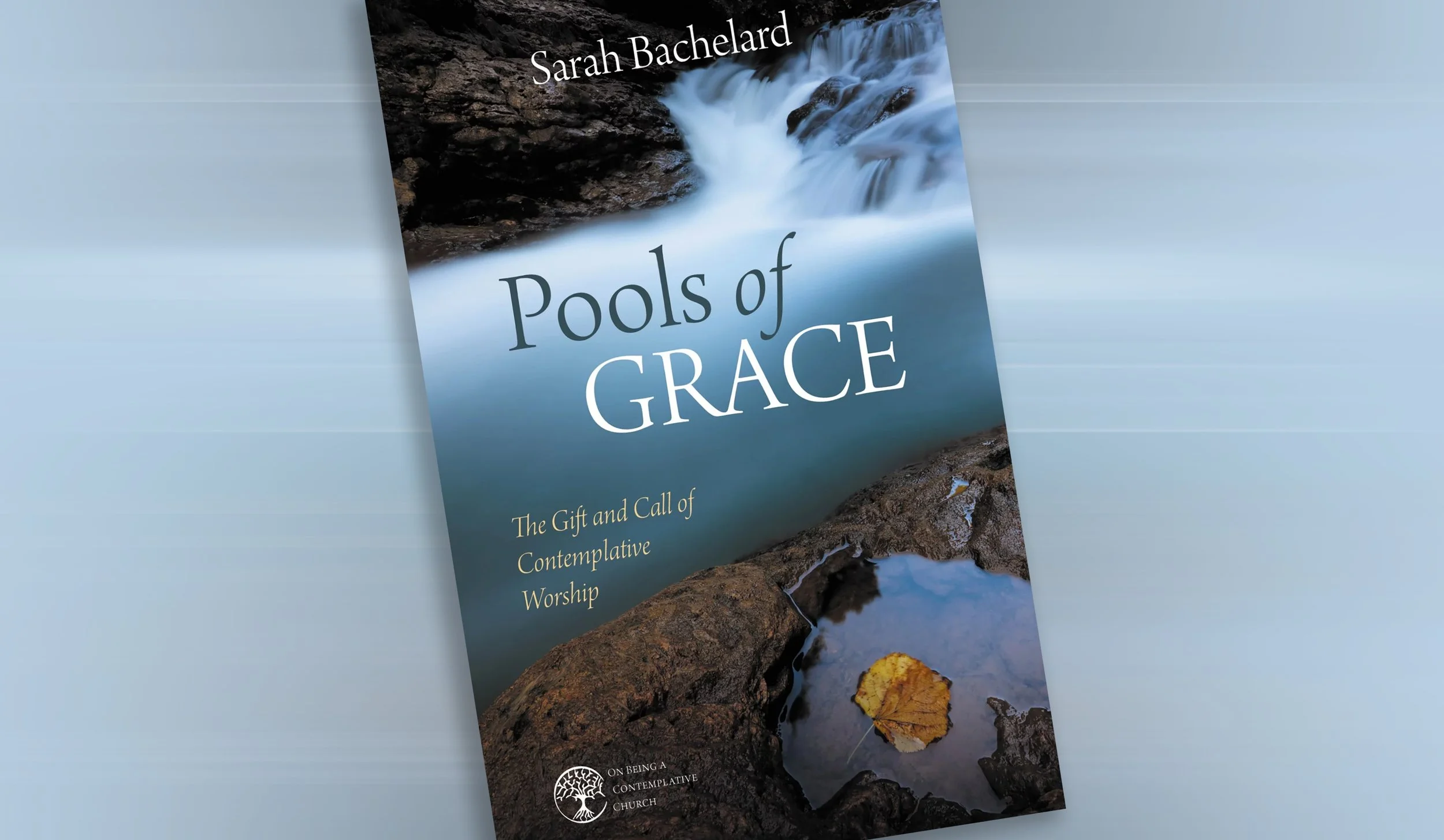
Silent meditation is a key component of the weekly worship service (online and in-person) offered by Benedictus Contemplative Church, Canberra, Australia. The church’s founding director, Dr Sarah Bachelard, in her latest book Pools of Grace: The Gift and Call of Contemplative Worship, explores the wisdom of prayerful silence particularly at this time of multiple world crises and existential anxiety for both the world and the church. In reviewing the book, the Rev’d Michael Wood reflects that it is out of a pool of silence that the life-giving words of liturgy can arise, and we come to know ourselves in loving and integral relationship with all of creation.
Ten years ago, I found myself sitting to next to Sarah Bachelard at the last night of an Anglican clergy conference in Perth, Western Australia, at which Sarah was the guest speaker. I recall bombarding her with questions about Benedictus Contemplative church in Canberra – its origins, vision, leadership, governance, and worship. Sarah bore with my relentless questions with patience and grace. I subsequently visited Benedictus to learn more and now, ten years later, we are experimenting with our own form of a weekly contemplative prayer service at St Stephen’s Anglican Church in Richmond.
What makes a church ‘contemplative’? Surely all prayer and liturgy are, by definition, contemplative in the sense that they are supposed to lead us into the contemplation of God. ‘Pools of Silence’ is the first of what will be a series of small books (On Being a Contemplative Church) exploring this question, both in terms of underlying theology/ethos and the particular form and shape this has been taking at Benedictus Contemplative Church in Canberra, Australia.
Two key hints to the direction and content of the book can be found in the title. Whatever the contemplative church is, it is both gift and call. As Dietrich Bonhoeffer emphasised, church is not our creation, but God’s gift (God’s own body), which has a particular calling in, to and for the world. In the first chapter, Sarah explores how the gift and call of the church is working itself out in the context of multiple world crises. We, including the church, are saturated in existential anxiety. This will obviously be reflected in how we embody the church’s call. When we, as humans are anxious, we frequently go into a ‘control and fix’ modality, standing over and against others instead of seeing ourselves as an integral part of the world, related to all living beings.
If I am hearing Sarah accurately, a significant aspect of the call of the church is learning to see (or learn to see again) reality clearly. She suggests that “contemplative consciousness and practice are at the heart of how we might begin to be more realistically in relation with the whole and form an intelligence adequate to the world itself” (p.8).
Another way of putting this is that it is the church’s vocation to learn to see as God sees and practise the implications of this as part of a ‘global web of life.’ We are all in this together! This drives us into silence (like Jesus is driven by the Spirit into the wilderness), in order to see more clearly and act more consciously. Why silence? Because in prayerful silence the Spirit begins to release us from our addictions to anxiety, command, and control.
Pools of Silence explores the relationship between silence and the words of worship. This is vitally important. As St Paul perceived so accurately, even the very best language – the most holy language – even of the language of the Bible and liturgy, under the deceptions of ego consciousness, can reinforce the illusion of our separateness and can be weaponised against others (Saul of Tarsus knew the scriptures well but misunderstood them to the extent of persecuting his enemies). So the gift and call of the church is nothing less than a conversion in which we know ourselves to be integrally, lovingly, in relationship with all creation, forming and being formed by it. No-one is expendable. Knowledge of our essential interconnectivity with all of life is one of the fruits of proximity to the God of Peace. Out of this awareness, born of silence, we begin to hear language (including scripture and tradition) anew. Citing Maggie Ross, Sarah notes that Christianity is a process more than a belief system: ‘Christ as way of knowing, Christ as a way of doing theology, of putting on the mind of Christ’ (p.16).
The practice of silence is a corollary of the kenotic pattern of Christ’s own life as he entrusts himself to God, refusing the mimetic entrapments of the world’s disoriented desires. Silence is foundational to contemplative church.
The above is only a snapshot of the rich seedbed which is laid in the first chapter of the book, out of which grows an exploration of contemplative worship. One of the things which I found so helpful in the book is that the reflections are constantly being referenced back to first principles. This is essential, because for anyone with a liturgical, catholic sensibility (which I share with Sarah), ‘mucking around’ with the prayer of the church is a potentially perilous undertaking. Liturgical ‘innovation’ is often met with eyes glazing over.
There are very good reasons for this. The liturgy can and does carry the Gospel of Jesus through history and facilitates direct encounter with the God revealed in Christ. And yet the liturgy is also a dynamic living tradition. Having spoken about the importance of silence, we return to the fact that humans are linguistic beings. Language is one vital way in which God reveals God’s self. The purpose of Christian language is to shape us into the pattern of Christ’s life – learning to perceive, see, live, and serve the world in a particular way. As I read Pools of Silence, I kept coming back to the image of a pool of silence out of which the life-giving words of liturgy arise.
Therefore, in a contemplative church, the questions of ‘which words do we use in worship’ is crucial. When I was a theological student, we were challenged to ‘write a new creed which expresses the core of the faith of the church.’ It proved to be far more difficult than we expected. Sarah Bachelard does not shy away from responding to such challenges. The remaining chapters are an illuminating example of creating liturgy from first principles. What is worship? Why do we do it? What work does it do? Who does the work? By what authority? Pools of silence outlines a theological rationale for how worship is structured at Benedictus: gathering – opening – welcoming – acknowledging – music – readings – reflecting[preaching] – holy communion – silence – concluding-sending. Each component of worship has a carefully considered purpose.
I was encouraged to read that the daunting task of responsibly and thoughtfully crafting worship has not just been the work of the author but also the careful and sustained work of a ‘liturgical group’ over many years. Witnessing to this collaborative process, one chapter is written by a member of the liturgy group, Jenny Stewart, who reflects on the creative process.
Pools of Silence will be helpful for anyone experimenting with contemplative prayer and worship. But rather than simply replicating a liturgy created by Benedictus Contemplative Church, the reader is given a ‘way of thinking’ about what liturgy is, how it works, what is important and why. Not every liturgist is going to come to the same conclusions or by the same process (after all, hundreds of textbooks have been written on the subject). But I found it refreshing to observe a group of people doing the creative work of contemplative worship in the Australian context, including being informed by indigenous wisdom. The book concludes with the full texts of two Benedictus liturgies.
‘Pools of Grace: The Gift and Call of Contemplative Worship’ is published by Wipf and Stock.
Michael Wood is Associate Priest at St Stephen’s Anglican Church, Richmond, Australia, which offers a contemplative service at 5pm on Sundays, and meditation on Wednesday evenings at 6pm, and Tuesday and Thursday mornings at 9am. Michael also works in private practice as a group facilitator and coach. Along with Sarah Bachelard and others, Michael is co-convening a ‘Emerging Contemplative Church’ gathering in Canberra on 15-17 October 2026. Information can be found here: https://bit.ly/41tP2bm
For more information about Benedictus Contemplative Church, click here: https://benedictus.com.au/