How can we keep hope alive when the forces of darkness are taking us to the very brink of the abyss? Roland Ashby reflects.
‘Keep hope alive!’ was a catch cry of courageous US civil rights leader and protégé of Martin Luther King, the Rev’d Jesse Jackson, who died recently. But I find it is increasingly difficult to keep hope alive in a world of sociopathic leaders obscenely glorifying in war, and a culture of greed and corruption resulting in inequality and climate collapse.
Keeping hope alive was something Jesus’ disciples found difficult too following his cruel torture and death by crucifixion. Just as keeping hope alive by all those now being bombed in the Middle East and Ukraine must feel impossible.
And just as the Roman empire and religious leadership conspired to murder Jesus, so now the American empire, together with Israel, and the theocratic leadership of Iran conspire to unleash terrifying suffering and destruction. This is truly diabolical, the work of darkness.
Those leaders who claim to be Christian are tragically and dangerously deluded if they think their faith gives them warrant to inflict such suffering and pain.
The basic tenets of the Christian faith – “God is love” … “Love your enemy” … “Blessed are the peacemakers” - are being betrayed by the ruthless and brutal exercise of raw power totally devoid of empathy or compassion. This is the antithesis of Christ.
So how do I keep hope alive, and maintain my faith in the power of the Holy Spirit, the power that Jesus said he would send after his death?
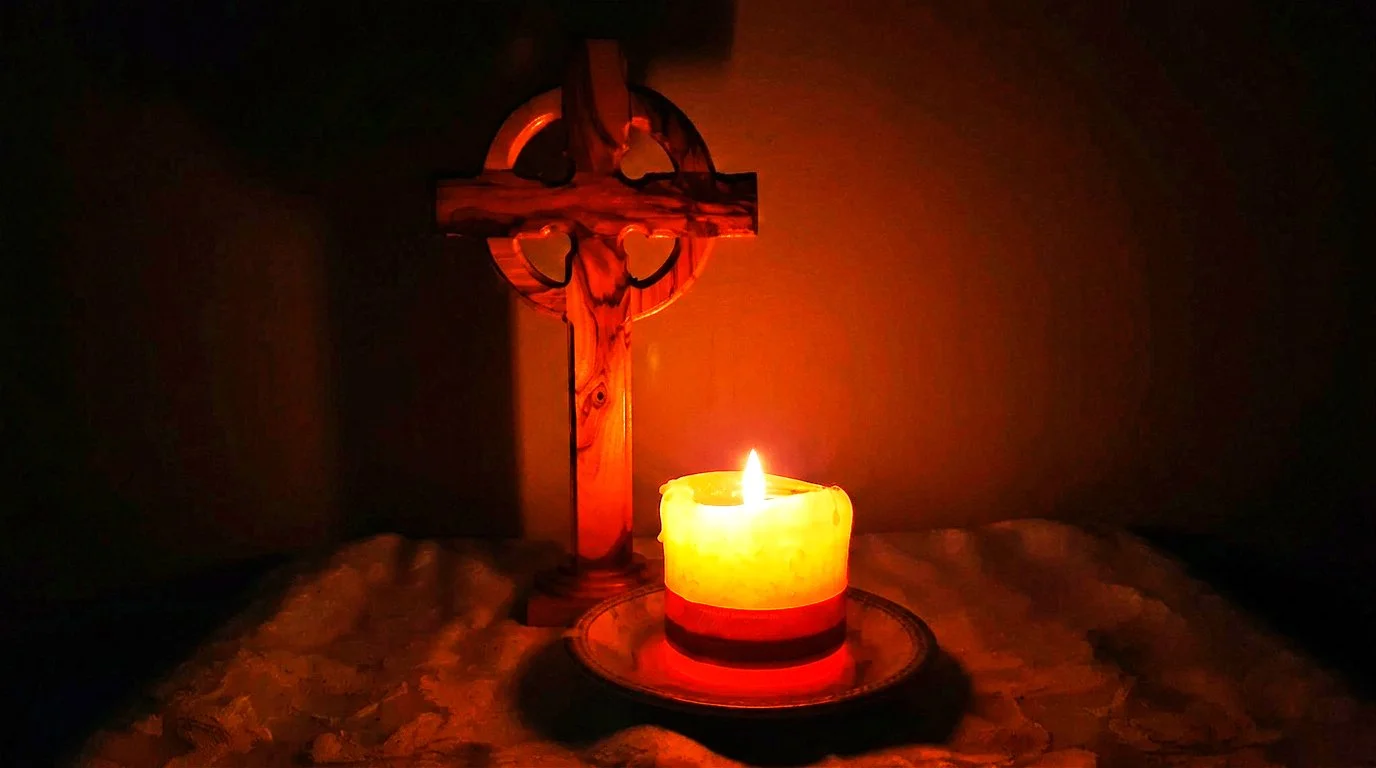
The Gospel of John tells us that “the Light shines in the darkness, but the darkness has not overcome it”. (John 1:5)
In his book Night, Elie Wiesel tells the story of the death camp Auschwitz. In one passage, a young boy is hanged for not keeping one of the camp rules. As his body dangled from the rope, Wiesel was asked by someone, “Where is God now?” and a voice within him replied, “Where is he? He is here – he is here hanging on this gallows.”
And in the Beatitudes (Matthew 5: 3-12), Jesus tells us that God is with all those who suffer and mourn, those who are merciful and of a gentle spirit, those who hunger and thirst for right relationship with others, and those who strive for peace.
He also said the two greatest commandments are to love God and to love your neighbour as yourself, and told us the story of The Good Samaritan, the ‘enemy’ who came to the rescue of the man who was violently assaulted and left for dead.
But we can only love our neighbours as ourselves, even those we regard as enemies, if we know ourselves as loved by God.
This is where meditation for me has been a lifesaver. Through meditation I have been able to verify through my own experience that I am loved and cherished and there is no need to hate myself or others. Meditation takes us into what the mystics call the cave of the heart and beyond the dualistic mind of “I’m good/they’re bad”, “I’m right/your wrong, I win/you lose”; and in the silence and stillness a knowledge of love arises from and through awareness of the Spirit dwelling within, the Spirit Christ promised to send us.
Benedictine monk John Main*, whose 100th anniversary occurs this year, says the most important thing that Christians have to proclaim to the world “is that the Holy Spirit dwells in our hearts and that, by turning to it with full attention, we too can live out of the fullness of love.”[1]
By a daily return to meditation, he says, we open ourselves “to the only reality that is ultimately real, the reality that is love.”[2]
In his 40 days in the Desert as preparation for his mission, the template that Christians use for Lent in the lead up to Easter, Jesus came face to face with his shadow – what author Andrew Mayes calls “the threefold temptation to power, prestige and pride”.[3] Only by facing these temptations and overcoming them was he able to begin his mission and ministry, in the power of the Holy Spirit (Luke 4:14). This power is the living water that Jesus offered the Samaritan woman at the Well. The Eastern Orthodox Church has made her a saint – Saint Photini – because, through her testimony, she went on to bring many Samaritans to faith.
Through contemplation, prayer and meditation, in solitude, silence and stillness, we too can find this living water, and become witnesses to it, in a world thirsting for peace and justice, and indeed, for the spring of water that gushes up to eternal life.
And we too will be able to sing the words of the hymn:
“I heard the voice of Jesus say, ‘Behold, I freely give the living water; thirsty one, stoop down, and drink and live!’ I came to Jesus, and I drank of that life-giving stream; my thirst was quenched, my soul revived, and now I live in him.”
*The World Community for Christian Meditation (WCCM) was created to foster John Main’s teaching. See: WCCM | The World Community for Christian Meditation
Roland Ashby leads an online meditation group on Tuesdays at 7.30pm (AEDT) via zoom, and co-leads an in-person group at St Stephen’s Anglican Church, 360 Church Street, Richmond, Victoria, on Wednesdays at 6pm. For more information email: editor@thelivingwater.com.au
References
[1] John Main, Moment of Christ – the Path of Meditation (Darton, Longman and Todd, London 1984) 41
[2] Ibid., 42
[3] Andrew D. Mayes, Beyond the Edge – Spiritual Transitions for Adventurous Souls (SPCK London 2013) 14