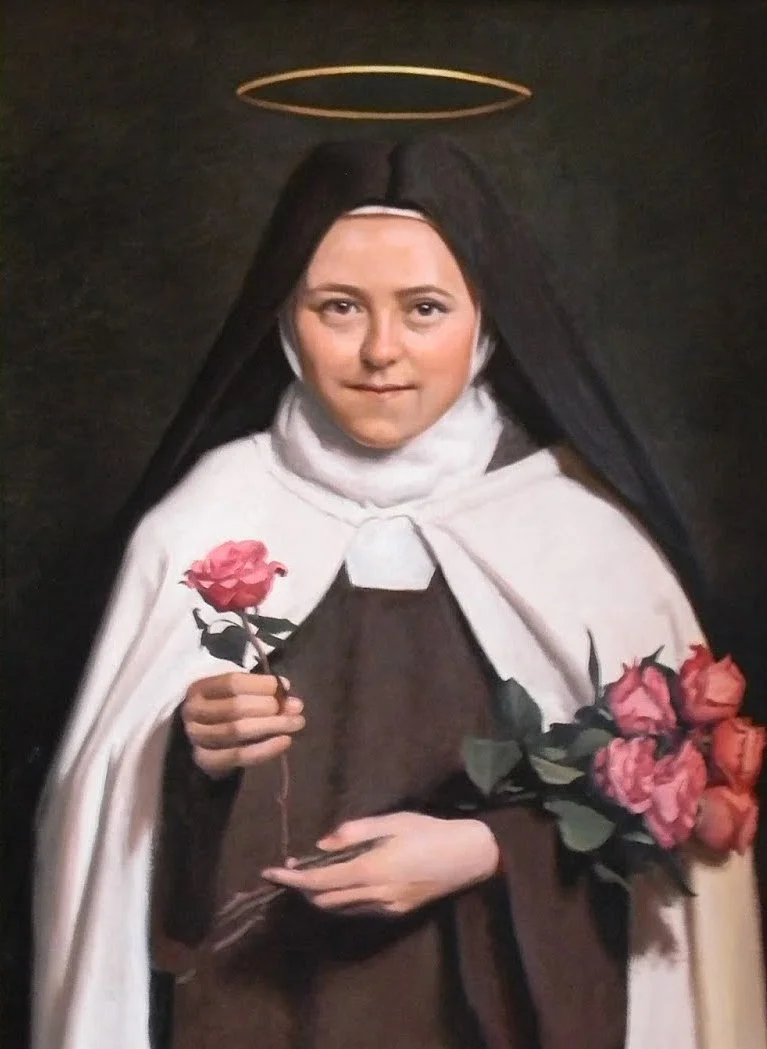
St Thérèse of Lisieux - 'When I die I will send down a shower of roses from the heavens'.
Painting by Henry Wingate
St Therese of Lisieux compared herself to a small wildflower whose ‘Little Way’ she believed was just as beloved of God as the life of the more ‘heroic’ disciple. Anglican priest and chaplain Dr Kathleen Alleaume-Ross, who completed a PhD on St Therese in 2020, reflects on how she came to love Therese from an early age, and how this love, which became more intense during a time of personal suffering, would inspire a vocation to the priesthood Thérèse herself had so desired.
Jesus set before me the book of nature; I understood how all the flowers [God] has created are beautiful, how the splendour of the rose and the whiteness of the lily do not take away the perfume of the little violet or the delightful simplicity of the daisy…. If all flowers wanted to be roses, nature would lose her springtime beauty, and the fields would no longer be decked out with wildflowers. And so it is in the world of souls. (Saint Thérèse of Lisieux, Story of a Soul)
Saint Thérèse of Lisieux was born Thérèse Martin, the ninth and last child of Louis and Zélie Martin in 1873 in the town of Alençon, in Normandie. When Thérèse’s mother Zélie, died in 1877, the Martin family moved to Lisieux.
In 1888, only fifteen, Thérèse joined two of her sisters in the Carmelite convent of Lisieux. Suffering from tuberculosis, she died nine years later, aged 24, on 30 September 1897. She was then unknown to the world. She only became known through her autobiography, The Story of a Soul. Thérèse began writing it in 1894 when her biological sisters asked her to document the evolution of her spiritual life. After her death, The Story of a Soul circulated as an obituary and quickly became a bestseller, leading to worldwide devotion and numerous miracles recorded as a Shower of Roses.[1] Thérèse was beatified in 1923, followed by her canonisation in 1925. It takes on average 100 years to be canonised once a process has begun, so 28 years is remarkable and due to the number of miracles attributed to her.
I encountered Saint Thérèse of Lisieux as a young girl in Mauritius, a small Island off the coast of Africa.
Sainte Thérèse de Lisieux embodied feminine grace and humility; her reception as a saint in the 1970’s emphasised her willingness to accept all suffering and offer it up to God. It was inevitable that her influence would be used to convince women they must bear any form of suffering in silence. I was not only uncomfortably vocal against women having to bear suffering in silence, but I also owned a teddy bear with interesting habits. I came from a practising Roman Catholic family that admired the priesthood above all else, so Monsignor the bear, dressed in baptismal dress, began to say Mass for all the toys. I seemed to know all the words, so unsurprisingly, this raised great concern among my relatives. They resorted to what they considered the best thing to do when a young woman needed ‘settling down’: reading me extracts from Sainte Thérèse’s The Story of a Soul. When Monsignor refused to stop saying Mass and proceeded to confessions, they read me letters written to and by Sainte Thérèse, then encouraged me to write similar letters to a relative who was a nun.
It is said that God works in mysterious ways, and this proved to be an excellent idea. To my surprise, resistance gave way to joy when I received the nun’s written replies, occasional visits, pink cakes and highly prized holy cards. At the time, I guiltily attributed my enthusiasm to greed and love of the lacy edges around the cards; but on reflection, I was surprised by my attention to the ‘matters of the soul’.
Thérèse’s writing style reflects the intimacy with which she addresses the reader and God (and I will comment on this again later). Thérèse’s joy and confidence in God’s unconditional love captured my attention. It provided such a great contrast to the Catholic guilt young Catholic girls experienced. Even then, I understood Thérèse’s claim that God’s love was available even to one like me.
In The Story of a Soul, she writes that even the wild ones are loved by God:
It is to their hearts that God deigns to lower Himself. These are the wildflowers whose simplicity attracts Him. When coming down in this way, God manifests His infinite grandeur. Just as the sun shines simultaneously on the tall cedars and on each little flower as though it were alone on the earth, so Our Lord is occupied with each soul as though there were no others like it.
It wasn’t lost on me that I was a wildflower in God’s garden of souls, a challenge to my concerned relatives. I didn’t ‘settle down’, but I also feel that God used their efforts to plant some very good seeds.
Unfortunately, I did leave Thérèse and Monsignor the Bear back in Mauritius. But nothing gets in the way of God’s plans, and I was reunited with Thérèse in Melbourne, Australia, in the early 2000’s. I was undertaking my Bachelor of Theology when I was offered some letters written to and from two priests in her spiritual care as options for an essay. I was struck by the empathy she felt for them. Everything Thérèse did was with love.
I am not a sentimental person, but being reunited with Thérèse felt like a thunderbolt. It was like finding an old friend who I suddenly realised had been by my side all along.
I became acutely aware of this when a devastating event in my life put an unwelcome pause to my studies. This crisis caused me to doubt everything. Desperate prayers were not immediately answered, but I eventually learnt that acceptance was the only way. I decided to salvage what I could from my doctoral studies. Returning to Thérèse’s writings, I felt comfort that I had not felt before. My challenge was to maintain faith that God would come through for us. God had somehow worked it, so the Little Way became the only way forward.
Her father Louis developed dementia, which resulted in his moving to a mental institution. This was a cause of great pain to Thérèse. She writes of this time: “I am suffering very much, but I feel I can still bear greater trials.”
Previously, Thérèse’s words would have left me bewildered: what did she mean that she could bear more suffering? Who thinks like that? But after my similar experience of a family member, her words were profoundly helpful. In our modern world, we treat suffering as an enemy. But God’s best work in us happens precisely in the horrific moments of suffering. The realisation that I could bear more was then, and still is, a relief. I learnt that spiritual strength is our most important asset.
I must admit that I am fortunate to be able to read Thérèse’s words in French; it is a gift, and I want to explain why.
Thérèse speaks directly to God and with irresistible intimacy, and that is a significant aspect of her spirituality. When speaking to God, Thérèse uses the word tu (more commonly used to address a friend or relative) instead of the usual vous (used to address one’s superiors). In French, this is simple courtesy. The fact that Thérèse chooses to do otherwise is significant, and the effect is that the God to whom Thérèse relates is familiar, loved and loving. Even more importantly, her God is one of love, not judgement.[2]
Similarly, Thérèse’s theology of a God of love rather than judgement was evident in the passage quoted at the start. Thérèse compares the world of souls to the flowers in a beautiful garden, each uniquely designed and loved by God, all equally beautiful. In other words, regardless of how the world sees us, we are all uniquely and equally important to God. These words offer enormous spiritual consolation - not to mention an antidote to self-devaluation - and reassurance that God has it all in hand. Such is the genius of the Little Way. It is available to one and all.
Thérèse compares herself to her forbear Teresa of Avila, to whom she admits she cannot aspire, as she is neither a great reformer nor a great mystic. But with God’s grace she developed her theology of the Little Way, which has taught me never to give up. She describes the Little Way in Manuscript C, her third manuscript of The Story of a Soul, addressed to her then superior, Marie de Gonzague.
She writes:
We are living now in an age of inventions, and we no longer have to take the trouble of climbing stairs for, in the homes of the rich, an elevator has replaced these very successfully. I wanted to find an elevator which would raise me to Jesus, for I am too small to climb the rough stairway of perfection. I searched, then, in the Scriptures for some sign of this elevator, the object of my desires, and I read these words coming from the mouth of Eternal Wisdom: ‘Whoever is a LITTLE ONE, let him come to me.’ And so I succeeded. I felt I had found what I was looking for. But wanting to know, O my God, what You would do to the very little one who answered Your call, I continued my search and this is what I discovered: ‘As one whom a mother caresses, so will I comfort you; you shall be carried at the breasts, and upon the knees they shall caress you.’
Words inspired by Matthew 19: 3-14, “Let the children come to me, and do not stop them, for it is to such as these that the kingdom of heaven belongs.” Thérèse is not encouraging us to act like a child. The childishness she refers to applies in relation only to God.
I realised then, and continue to realise, that the Little Way is the only way. It is ‘a calling on our lives’ to be as God has created us and accept this, and when Therese wrote of her desire to be a priest it resonated poignantly with me and my call to the priesthood.
In the original title of the talk on which this article is based, I described Sainte Thérèse of Lisieux as ‘non-heroic’; I was borrowing a term from an article by literary historian Barbara Corrado Pope on Thérèse of Lisieux, “A Heroine Without Heroics”, in which she describes Thérèse of Lisieux as not being characterised by ‘heroics’ normally attributed to other great saints. [3]
This is what makes Thérèse so special, and this is why she speaks powerfully to ordinary people including me. Thérèse is like everyone else. But make no mistake, this does not let us off the hook; quite the opposite. We are all called to the saints. Following the Little Way is not easy; Thérèse herself has been described as a spiritual athlete.
In my doctoral thesis, I wrote about how Thérèse’s spirituality inspired the trope of the hidden saints in literature, especially in the trope of the Good Priest in French literature. The Good Priest inspires and loves his parishioners but often comes into conflict with the hierarchy. Even before her time, hidden sanctity was valued and was embodied by the person of the Curé D’Ars (St John Vianney), whom the French thought of as the ‘real deal’.
Thérèse teaches that there is the way of the world, and then there is God’s way, in which we both receive his favour and are called to courageously follow his will. My personal calling has been a ministry to those on the fringes of society, particularly in the areas of mental health, palliative care and criminal justice. Whilst I never consciously intended to imitate her, it is worth noting that Thérèse took an interest in assisted dying, as well as those sisters in the Carmel whose lives were challenged by mental health issues, bad humour and other challenges[4]. Many of them testified during her process for canonisation. She also took an interest in prisoners, one of them a murderer called Pranzini. [5]
I commend to you Saint Thérèse of Lisieux, unknown during her lifetime but known ever since. Thérèse is famous for numerous graces and miracles that are referred to as a Shower of Roses. I like to think I caught one of these roses.
For those who wish to read her autobiography, I recommend: Story of a Soul - The Autobiography of St. Thérèse of Lisieux, translated from the original manuscripts, John Clarke, O.C.D., by Third Edition, ICS Publications, Institute of Carmelite Studies, Washington, D.C.
Please also see Archives Archive — Archives of the Carmel of Lisieux which are available in English.
This article is based on an online talk that Dr Alleaume-Ross gave at The Well on 11 October. A recording is available HERE. Use passcode: ^HD4n&QX
At the next meeting of The Well on Sunday 8 November at 7.30pm (AEDT), Fr Grant Bullen will reflect on how Trappist monk Thomas Keating has nourished his faith. For more information and the Zoom link, click here.
References:
[1] Three volumes of this document were published in 1911, 1912 and 1913. The historiography is explained by Antoinette Guise Castelnuovo, “Les Miracles de Soeur Thérèse de L’Enfant-Jésus Entre 1898 et 1926: Genèse d’un Culte” (Section des Sciences Religieuses de l’École Pratique des Hautes Études, 2000), 24–25.
[2] I note that I refer to Thérèse (rather than Saint Thérèse), because she feels like my friend.
[3]This is discussed in Barbara Corrado Pope, “A Heroine without Heroics: The Little Flower of Jesus and Her Times”, Church History 57 (1988), 54.
[4]Thérèse writes: ‘It cost me very much to offer myself for this little service because I knew it was not easy to please Sister St. Pierre. She was suffering very much, and she did not like it when her helpers were changed. However, I did not want to lose such a beautiful opportunity for exercising charity, remembering the words of Jesus: “Whatever you do to the least of my brothers, you do to me.” I offered myself very humbly to lead her, and it was with a great deal of trouble that I succeeded in having my services accepted!’ MS A 28v
[5] Thérèse writes: ‘To awaken my zeal God showed me my desires were pleasing to Him. I heard talk of a great criminal just condemned to death for some horrible crimes; everything pointed to the fact that he would die impenitent. I wanted at all costs to prevent him from falling into hell, and to attain my purpose I employed every means imaginable.’ MS A 45v