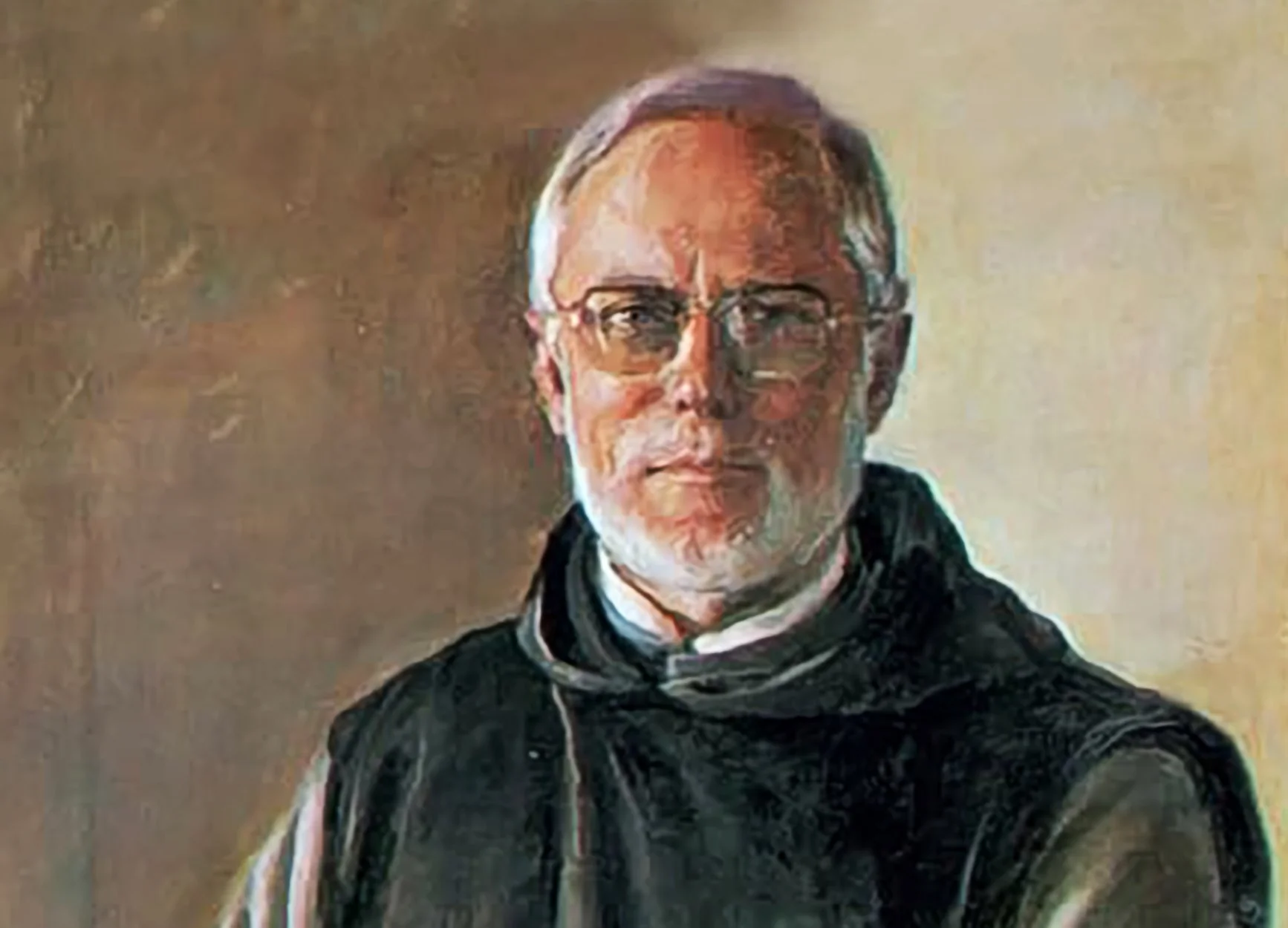
John Main OSB, whose centenary occurs this year.
When Dr Ruth Fowler* first heard the words of Benedictine monk John Main (1926-1982) she says that deep within she knew that he knew God. In her previous article (www.thelivingwater.com.au/blog/recovering-the-importance-of-teachers-who-live-out-of-divine-presence) she spoke of the importance for Western Christians of recovering the place of the teacher in the spiritual journey—one who has been graced with the gift of Divine intimacy and whose spiritual authority is recognised by others.[1] In this article, Dr Fowler, a long-time spiritual director and meditator, reflects on how John Main, whom she describes as a “love mystic”, and whose 100th anniversary is celebrated this year, embodied such a teacher.
I first heard of John Main in December 1982. It was on the very first evening I visited the Benedictine monastery, then at Pennant Hills in Sydney, to discern a monastic vocation. At the beginning of Vespers, the Abbess read out a telegram advising the community of the death of John Main in Montreal.
I did not know then the extraordinary interior and exterior gateways that would open before me through this man’s life and teaching. Later, during that monastic stay, one of John Main’s newsletters was read aloud in the refectory as we ate in silence. I was immediately arrested by his words. I sensed in them an authentic knowing of God. Somewhere deep within me, I knew that he knew God. Even the silences between his words seemed filled with Divine Mystery.
I feel profoundly grateful for the way John Main’s person and teaching have entered my life and continue to shape me. Being led to John Main has, without doubt, been one of the great graces of my life. So, I offer these brief reflections in deep gratitude, love and humility, knowing that words can only ever do partial justice to such a witness—such an icon of Christ.
Through both his written and auditory teachings and his person as described by many who met him, John Main has much to show Western Christians today about what it means to exercise the gift of spiritual authority. His own spiritual journey also makes clear that this gift is inseparable from the grace of contemplation. John Main knew in his own experience the Divine Mystery and the depths of the spiritual journey—it was from this lived knowledge that his authority as a teacher emerged. His own maturing in the Spirit through the deepening of silence within him, occurred at a very fertile time in Western Christianity.
In the 1960’s there was a growing Western longing for deeper interiority and spiritual experience which drew many young people to India and other parts of Asia. This wider movement of spiritual seeking also began to enter Western Christianity, awakening a renewed interest in the Christian contemplative traditions of profound depth that had, in many places, been largely forgotten.
We have the extraordinary privilege of living at a time when the contemplative life is being rediscovered in Western Christianity, by lay and religious alike. With this comes the recovery of something else the Church had almost forgotten: the importance of the spiritual teacher—one whose life is rooted in God, and whose lived experience enables them to guide others towards that same depth of realisation.
Charismatic Authority
John Main was recognised as one such teacher. His spiritual authority was charismatic in the original Christian sense of the word; charisma meaning a free gift of the Holy Spirit. He was not solely a contemplative but a compelling example of a teacher who exercised the charism of spiritual authority. This was not because he claimed special status or mystical privilege, but because his life and presence embodied his intimacy with the Divine Mystery, the gift of discernment, and his love for others who recognised that his presence and teachings seeded love and freedom in themselves and others, fostering their own spiritual growth.[2]
In language that resists idolisation, those who knew him personally describe him as attentive, humble, loving, deeply peaceful and very present.[3] Even one who knew him as a spiritual guide through his teachings, but had never met him, said on hearing of his death, “How I loved that man.”[4] Patrick Murray, who was an Irish missionary priest in Africa, first heard John Main on tape and only years later met him in person in Montreal.
As soon as I heard John Main's voice, the very sound, the very tonality of his voice struck something deep within my very being. And as I listened to him … there was something in my inner self that said it all made sense. I sensed deep within that even if I did not understand, he was saying something significant and that I would like to meet this man.[5]
It is impossible to miss the spiritual significance of this moment for Patrick Murray. The recognition voiced by many who knew him underscores something much deeper than surface personality traits. They suggest an inner transformation to which he had assented. As Laurence Freeman said:
For him – as for the monks of the Christian Desert he had learned from – this meant rediscovering the power of prayer as a way of personal, interior transformation. It meant seeing that all prayer leads to contemplation which is the ultimate goal of human life.[6]
The descriptions recall the abba or amma of the Desert tradition: one whose wisdom is recognised by others because their life, with all its challenges, has become increasingly transparent[7] or open to the indwelling Christ. He could be described as a modern-day Spirit-bearer[8].
Perhaps some of us can remember our own first encounter with John Main—the first time we heard his voice, read his words or encountered the practice he taught.
Lived Experience of God
In my first article and in this I recall the impact of my own first encounter with John Main’s words. What I sensed was an intimacy with God—a truth I heard in his voice and recognised in his words. He was not speaking about the spiritual journey or union with God from theory or theological knowledge, rather his teaching arose from somewhere deeper—from his own experience of Divine Mystery and the transformation of his life triggered by this intimacy with God.
This transformation came through his commitment to silence—to a kenosis of self, through the repetition of the mantra. Unlike earlier forms of monastic asceticism, where kenosis might involve poverty, fasting, self-denial of food or sleep, the kenotic practice taught by John Main was the practice of turning away from our preoccupation with ourselves. Such a practice of meditation, faithfully followed, gradually empties the surface self-consciousness so that we may become receptive to the fullness of God and awaken to the truth of our being in God.
This is important for understanding John Main as a spiritual teacher. His authority rested not upon what he had read, but upon a life tested and transformed through the practice of silence and attention—and recognised as such by others. The fruit of such kenosis is love.
An early Montreal meditator described the atmosphere of the Priory in these words: “everything ran smoothly in the Priory, because while he [Fr John] ruled with authority he also ruled with love.”[9]
That combination is important. Authority and love were not opposites for John Main. Over many years, his silent attentiveness to the indwelling Christ rendered him increasingly transparent to the fire of Divine Love. This was both the source of his gifted insight and his capacity for love. Laurence Freeman described John Main when he was dying:
“He was increasingly silent yet did not appear withdrawn. His silence made him more present. It intensified the quality of his love.”[10]
That is a very beautiful description of the fruit of contemplation. Silence did not make John Main less human; it made him more present. It did not remove him from relationship but deepened his capacity for relationship.
Encouraged by the witness of his example I immersed myself in the practice as John Main taught it. As I did, I found myself responding very deeply to its call. Gradually, almost imperceptibly, I began to realise that something was changing within me. Others remarked that I was becoming simpler. The meditation was, as it were, beginning to penetrate my granite heart and bear fruit.
A God of Love and Abundant Generosity
The God, John Main knew was not a judging God—rather he encountered a God of love, abundance and generosity. At the heart of his personal experience was a God who desires that we should grow and mature—to come to “fullness of life, fullness of love, fullness of wisdom.”[11]
The promise of this loving and abundant God held out an extraordinary possibility. I could believe that such riches awaited us because I sensed John Main had, in some measure, already revealed their presence in his own being. So, the practice he taught held—and still holds—for me, an infinite promise. I believed it because I sensed its realisation in him.
Father Paul Geraghty, a spiritual son of John Main, recalled asking him whether he had ever had an enlightenment experience. John Main replied that he had—and had “almost fallen off a cliff.” When asked what it meant, he simply answered: “I realised there is only love … there is only love.”[12]
For John Main, Love was the fruit and goal of the kenotic journey. Faithful repetition of the mantra becomes a way of relinquishing the self and opening to Divine Love at the core of our being. This realisation of our already immersion in the Mystery of Love became the source from which his teaching flowed and, I believe, the reason why it touched so many people.
Polly Schofield, an early meditator in Montreal, recalled:
“Yes, Father John was a man of Love. Ultimately, that was the only thing that mattered to him; everything he did flowed from this. He said he was in love with everyone he spoke with, and he was in love with ‘the Spirit that enfolds the whole universe in his hands, and in silence is loving to all.’ This is the Spirit in my heart.” [13]
Whether he spoke of the Father, Christ, the Spirit or the Trinity, it was love—and the reciprocity of love realised within the meditator—that constituted the Divine milieu of his understanding of prayer. “In this is love, not that we loved God but that he loved us and sent his Son.” 1Jn 4:10.
We are birthed into consciousness by God’s presence; the Holy Spirit is breathed into us. Then we awaken, with growing wonder, awe and joyful confidence, to our own reality in God’s presence around us.
Love and interior freedom are inseparable. Awakening to this Love releases us into the freedom and creativity of divine life, bringing forth the knowledge that is wisdom. While some have described John Main as a Trinitarian mystic, and there is certainly a Trinitarian character to his spirituality, I prefer to call him a Love Mystic. For it was Love—the Divine life permeating the universe, arising in the depths of our being and encountered throughout creation—that filled his awareness and inspired his pilgrimage.
He Loved People, Life and God
Paul Harris’s book, John Main: By Those Who Knew Him, is such an invaluable resource because it allows us to encounter John Main through the eyes of those who knew him. He was a man deeply in love with people, with life and with God.
Again and again, those who met him spoke of the sense that they were loved by him. This was not a sentimental love, nor was it a way of controlling others through affection. It was a love that recognised the dignity and potential of the person before him.
As a Benedictine, John Main had a deeply sacramental and incarnational vision of the human person. He saw creation as revealing its Creator and reflecting the glory of God. His teaching on Christian meditation does not invite us to escape the world in order to find God, but to discover God more deeply within it.
He was deeply concerned with the whole person and with our becoming who we were created to be. Prayer and meditation therefore involve the whole person—body, mind, psyche and spirit. The body is not merely a vessel for some more “spiritual” self; it is the place where our relationship with God is lived.
John Main expressed this very simply:
“If I hear some joyful news, I feel that joy in my body, I know it in my mind, and it expands my spirit.” [14]
Meditation, then, is not an escape from our embodied existence, but a movement towards greater integration, greater freedom and a fuller humanity.
The Ordinary is Sacramental
This also explains John Main's appreciation of everyday life. He delighted in opera, fine food, fine wine, books, horse racing and beautiful things. He did not believe holiness required turning away from what is good and beautiful. His appreciation of the material world arose from a deeper theological conviction: if God has assumed human material existence in Christ, then matter and creation cannot be spiritually irrelevant.
One person remembered how John Main could take something as ordinary as a day's journey—a car trip into the mountains and back—and imbue the whole experience with spiritual meaning. He had, the person said, “a very passionate sense of the meaning of life.” The ordinary is sacred and becomes a place of encounter.
And yet—and this is equally important—John Main could also leave these beautiful things behind. He loved the world, but he was not attached to it. He valued community life because he understood it as the place in which we learn to love God and one another. But he was not naïve about community, nor about the people who came to him. He was wary of those who wanted to make him into a guru. He avoided people who were merely curious or who sought something from him without being prepared to undertake the discipline of the path themselves.
Embodying the Fruits of Contemplation
In an authentic teacher, the fruits of contemplation become evident in their being and life. The goal of contemplation is not simply spiritual knowledge or extraordinary experience. Contemplation must become visible in our transformation—in how we live—in compassion, humility, patience, interior freedom and especially love. The goal for the human person is to become one in God.
This was something I sensed John Main embodied in his seemingly effortless transmission of wisdom and love, and those who knew him personally frequently alluded to it. His authority was not simply that he knew about contemplation, but that his life had become a witness to the transforming Love he encountered in contemplation.
John Main said that he entered the monastery because he wanted to become interiorly free. That desire for freedom was not an escape from relationship or responsibility. Rather, interior freedom makes possible a deeper capacity to love God and all creation. As we become less preoccupied with ourselves, the inner veils dimming the Christ-light within are gradually removed. The person becomes more and more translucent to the indwelling Christ. In this transparency an interior freedom to love is released from its deep source within. In that freedom, we radiate something of the Mystery encountered in silence and discern the Spirit at work in the heart of another. Such was the case with John Main. Paul LaFontaine remembered him as “a man who was very gentle, a man who saw deep into my heart.”[15]
Even though John Main taught a practice of silent meditation, his spirituality resists any dualism that separates spirit from body or prayer from ordinary life. That fullness of love for all creation was not simply something John Main talked about; it was something I sensed he embodied.
He Consistently Pointed Beyond Himself
One of the hallmarks of a teacher who has spiritual authority is that he or she does not create dependence upon themselves. Rather, the authentic teacher frees the seeker to enter more deeply into their own relationship with God. John Main consistently emphasised that the goal of meditation was deepening communion with Christ. He encouraged those who came to him to trust the discipline rather than become preoccupied with passing experiences; to persevere faithfully in daily practice; to become less self-centred rather than increasingly fascinated with one’s own spiritual development and with grace, to discover the indwelling presence of Christ.
He revealed the spiritual guide who gradually made himself less central. His role was not to draw people towards himself, but to point beyond himself to Christ. Again and again, he returned to the same fundamental invitation: we are called to become the person we were created to be. John Main invites us into the freedom of our own relationship with God.
This is the paradox of spiritual authority: the more authentic it is, the less it seeks to possess the other. Its purpose is to serve the other’s freedom. And this is inseparable from humility.
Humility
John Main once told his sister Yvonne that pride was his chief failing. Yet for him, the ascetical path towards humility was not primarily through the mortification of body or soul, as earlier forms of asceticism had often understood it. Rather, humility was cultivated through the practice of turning aside from self-consciousness in meditation.
In silence, the meditator turns from the incessant preoccupation with the self and opens into the Mystery of God's own self-knowledge. In doing so, we grow not only in self-knowledge but in humility.
Yet humility needs to be approached with care. Traditional forms of the virtue have sometimes fostered a diminished or worthless sense of self, particularly for women. Such self-denigration cannot lead to the fullness of life in God. We cannot reject (or not like) the gift of our own being without, in some sense, rejecting the Giver.
Christian humility is therefore not self-negation but the fruit of continually reorienting ourselves towards Divine Love and opening to the grace of contemplation. It is not the destruction of the self but its right ordering within the Mystery of God.
The same paradox can be seen in John Main. His humility did not require him to hide his gifts or his spiritual authority. It made that authority trustworthy. Because he did not need to make himself the centre, he could become a transparent instrument of the Christ to whom he pointed.
Laurence Freeman captured this well when he said:
“He stands in the great tradition: the living tradition of Christian teachers of prayer whose authority derives from the humility and love of their discipleship to Christ.”[16]
Perhaps this is one of the clearest marks of authentic spiritual authority: the teacher reveals Christ but does not become the destination. The teacher becomes a sign pointing beyond himself or herself to the One who is both the Infinite source and goal of the journey. Humility does not diminish spiritual authority; it authenticates it.
Total Commitment to the Discipline
John Main consistently emphasised that the commitment required by the contemplative path was absolute:
“The depth of commitment to which we are called is absolute …”[17]
He embodied this priority in his own life. Even visits from distinguished guests as Yehudi Menuhin or the former PM of Canada, Pierre Trudeau were graciously curtailed when the time for meditation approached. If he attended the Opera, he would leave before the end so that he could return in time to meditate with the monastic community. These are charming anecdotes, but they reveal something important. Meditation was not something to be fitted into life when convenient. It was a practice around which life was ordered.
At the same time, John Main warned against becoming attached to experiences that might arise in prayer. Visions were not the goal. Feelings were not the measure of prayer. Consolations would come and go. What mattered was fidelity to the practice.
This restraint protected meditators from confusing unusual or altered states of consciousness with genuine contemplative transformation. The measure of prayer was not what happened during meditation, but what gradually happened in our lives: are we revealing greater freedom, becoming more loving, showing greater compassion, humility and attentiveness to others and to God?
Teaching That Creates Freedom
Authentic teaching enlarges freedom. People who lived and worked with John Main often remarked upon the way they felt accepted, listened to and encouraged in his presence. They did not experience him as manipulative or controlling. He did not impose himself upon them. Instead, he created conditions in which people could discover God's action within themselves.
Authority, properly understood, does not diminish freedom; it serves its maturation. The teacher's task is not to take possession of another person's spiritual life, but to accompany them towards greater freedom in God. John Main's authority therefore operated in a paradoxical way. The more deeply people trusted his teaching, the less dependent they became upon him personally. He taught them a discipline through which they could learn to attend for themselves to the presence of Christ within. This is very different from the kind of authority that seeks to control and is particularly important for us today.
But I do not wish to suggest that he was without human frailties. Sr Madeleine Simon, recalled:
“I remember once at Ealing, in the period after the meditation, when he had made some particularly devastating statement, and he smiled and said, ‘You must forgive me. I was a public prosecutor at one period of my life, and my brethren tell me I have been prosecuting ever since.’”[18]
We live in a culture that is deeply suspicious of authority—and often for very good reasons. But the answer cannot simply be to abandon authority. We need to recover a form of authority that is of the Spirit – one that is grounded in love, humility, experience and service to the freedom of another. John Main gives us an example of what that might look like.
A Living Tradition
Another strong sign of a genuine spiritual teacher is what happens after the teacher is gone. John Main died in 1982, yet the community he helped to establish did not collapse with his death. What he transmitted was not simply a body of ideas associated with his personality, but a living tradition of prayer.
John Main handed on a practice that could take root, mature and bear fruit in others. The community he left behind was not dependent upon his or her continuing presence. The teacher transmits something that belongs ultimately to the Divine Mystery.
A Model for Western Christianity Today
The example of John Main suggests that we need teachers who reveal in their being and their lives genuine spiritual authority. Such authority:
arises from a life shaped by prayer;
is recognised by others rather than claimed;
transmits a living tradition rather than merely personal opinions;
forms mature disciples rather than dependent followers;
combines humility with quiet confidence;
creates rather than diminishes freedom; and
continually directs attention beyond the teacher to Christ.
In this sense, John Main exemplifies what the Christian tradition has variously described as spiritual fatherhood or spiritual eldership: a gift through which a person's lived participation in God enables them to guide others wisely along the contemplative path. What makes John Main particularly significant for Western Christianity is the way in which he exercised this charism within a modern context. He spoke to educated, often sceptical Christians without demanding that they first accept his authority. He did not seek to persuade them primarily through theological argument or personal charisma. Instead, he invited them into a disciplined practice and trusted that faithful meditation would itself disclose the transforming presence of Christ in their own experience. His authority was therefore less that of a director issuing instructions than that of a witness, an icon of Christ who was himself also the message and whose life gave credibility to what he taught. While experience in the Community suggests that for many meditators additional healing work may also be important, the priority on the twice daily practice of meditation is foundational and central.
In John Main we see, therefore, not simply an influential teacher of meditation, but a person in whom the charism of spiritual authority was embodied: an authority grounded in contemplative experience, exercised in love, humility and discernment, recognised by others, and ultimately directed beyond himself towards Christ.
What Does it Mean for Us to Receive a Teacher?
I have tried to illuminate the importance of a teacher for those who seriously wish to follow a spiritual path. But the reality in Western Christianity is that we have largely forgotten how to be an apprentice on the spiritual path—especially in the way that leads to full maturity in the Spirit and, by grace, towards realising our oneness in God.
We have to relearn how to be seekers who are willing to learn from the Spirit-bearers, living and dead. So how do we receive someone such as John Main as our teacher?
I don't think the answer is simply to read more of his books, listen to more of his talks or know more about his life, although these can help. But this can also allow us to remain an observer, a bystander to John Main’s journey. To receive a teacher perhaps means something much more demanding. It means allowing the teaching to form me. It means submitting myself to the discipline that the teacher has transmitted. It means allowing the teacher’s understanding of prayer to challenge my own assumptions. It means persevering when meditation seems dry or difficult, rather than constantly looking for something new.
It means allowing the fruits of the practice to be tested in the ordinary circumstances of my life—in how I relate to people, how I respond when I am frustrated, how I deal with my own need to be recognised, how freely I can love. And it means especially having the humility to allow myself to be taught. This last is perhaps the most difficult for us as modern Western people.
We are very comfortable with acquiring information. We are much less comfortable with apprenticeship. We like to choose, evaluate and decide for ourselves. But the contemplative path asks something different. It asks whether we are willing to become teachable. Not passive. Not uncritical. But receptive. Are we willing to learn from someone whose experience of God is deeper than our own.
This is why I am drawn to the words of Bobrinskoy I referred to in the first article:
“I want to base myself with my whole being, without dissolving myself, on the experience of the saints.”
I think this is a profound description of what it means to have a spiritual teacher. “To base myself with my whole being” does not mean surrendering my own identity or judgment. “Without dissolving myself” is crucial. The teacher does not replace me. The teacher helps me become more fully myself in God. And “on the experience of the saints” acknowledges something that our contemporary culture can find difficult to accept, that we need those who are further down the track in the spiritual life than we are. We can receive. We can grow. We can stand upon the experience of those who have gone before us.
For me, John Main is a Spirit-bearer whose life and teaching have given me a way into the Christian contemplative tradition. But ultimately, he does not ask me to stop with him. He asks me to repeat the mantra, turn away from a preoccupation with myself, to enter the silence and to allow the awareness of the indwelling Christ to expand within me. To allow Divine Love to transform me. And so, gradually, to become who I was created to be.
I suggest that this is what it means to be an apprentice in the spiritual life. To receive the teacher without becoming dependent upon the teacher. To allow another's experience of God to become a trustworthy guide for our own journey. To learn from the Spirit-bearer while remaining open to the Spirit. And finally, to follow the teacher beyond the teacher—to Christ, who is both the source and the goal of the journey.
*Dr Fowler was the co-founder of WCCM Australia in Victoria in 1985, (known then as the Australian Christian Meditation Community) and led the Community in its formative early years. Since that time, she has given workshops and retreats both here in Australia and overseas, assisting adults to deepen their practice and understanding of the path of Christian meditation, as well as working with teachers on ways of introducing Christian meditation into schools and parishes. Ruth is profoundly grateful for the spiritual home that this Community has been for her and in particular the inspiration of its spiritual Father, John Main OSB. She continues to lead a weekly Christian meditation group online.
Ruth has lived in both Christian (with the Benedictines, now at Jamberoo Abbey) and non-Christian (India) monastic settings, which she regards as foundational in her spiritual path. She has been a spiritual director for many years, regarding this as a profound grace and privilege. Ruth recently completed a PhD at the University of Divinity entitled, The Charism of Spiritual Authority: A Call to Recover the Heart of Spiritual Guidance in Western Christianity, reflecting her concerns for the recovery of contemplative prayer, the importance of a teacher in the contemplative path and the relationship of these to spiritual guidance. Prior to her retirement in 2007 from the paid workforce Ruth was a Public Servant in the Victorian Government and a secondary school teacher in State and Catholic schools and active in the alternative school movement and teacher union politics.
References
[1] Drawing on Kallistos Ware (The Inner Kingdom, [St Vladimir’s Seminary Press, Crestwood, NY, 2001] 127-151), I suggest that the charism of spiritual authority has five key characteristics – profound intimacy with God, the gift of discernment, capacity for loving relationship, recognition by others as having spiritual authority and through their own transparency to Christ sanctify others through their presence. These characteristics, I suggest, can be seen in John Main.
[2] Paul Harris,ed. John Main By Those Who Knew Him, (London: Darton, Longman & Todd, 1991).
[3] Paul Harris, ed. John Main By Those Who Knew Him, 123—365.
[4] Paul Harris, ed. John Main By Those Who Knew Him, 216.
[5] Paul Harris,ed. John Main By Those Who Knew Him, 100.
[6] Laurence Freeman, “Homily - John Main Memorial Eucharist,” (Westminster Cathedral, 29th Dec 2007). https://wccm.org/content/john-main-memorial-eucharist-westminster-cathedral/ .
[7] The term “transparency” is one I prefer as a way of describing the fruit of the spiritual path. Transparency to the indwelling Christ is a fruit of the transformation that occurs as we become less self-preoccupied and increasingly receptive to the Christ who dwells within. It speaks to the wholeness of the spiritual journey: as we become increasingly aligned with God, our whole being—body, mind and spirit—is gradually illumined by this inner Light of Love. The unique person we are does not disappear; rather, our true self, the person we were created to be, becomes increasingly transparent to the One who dwells within. In this transparency, Christ’s love can shine through our presence, so that others are drawn not to ourselves but beyond ourselves to God.
[8] The term “Spiritbearer” (pneumatophoros) goes back to the hermetic writings and is also found in the Old Testament (LXX): Hos. 9:7 and Zeph [Sophonias] 3:4. Its first use in the Christian tradition is in The Shepherd of Hermas, Mandate 11:16. In, Tim Vivian, St. Macarius The Spirit Bearer: Coptic Texts Relating To Saint Macarius The Great, (Yonkers, NY, St Vladimir's Seminary Press, 2004) Kindle Edition, 34. Kallistos Ware said, “The whole aim of the Christian life is to be a Spirit-bearer, to live in the Spirit of God, to breathe the Spirit of God.” (The Orthodox Way, St Vladimirs Seminary Press, Yonkers, NY. 2004)
[9] Paul Harris,ed. John Main By Those Who Knew Him, 91.
[10] Laurence Freeman, ed. John Main: Essential Writings, Modern Spiritual Masters Series (Maryknoll, NY: Orbis Books), 48.
[11] John Main, Moment of Christ: The Path of Meditation, (New York, NY, The Continuum Publishing Coy, 1999), 76.
[12] Personal conversation via Zoom with Fr. Paul Geraghty, in Zoom call Montreal - Melbourne, 6th June, 2023.
[13] Paul T Harris ed., John Main: By Those Who Knew Him. 345.
[14] John Main, Word Into Silence: A Manual for Christian Meditation. 1980. Reprint, London: Canterbury Press Norwich, 2019. 65—66.
[15] Paul T Harris ed., John Main: By Those Who Knew Him. 174.
[16] Paul T Harris ed., John Main: By Those Who Knew Him.16.
[17] Main, “Letters From the Heart,” 57, Newsletter, April 1978.
[18] Paul T Harris ed., John Main: By Those Who Knew Him. 218.