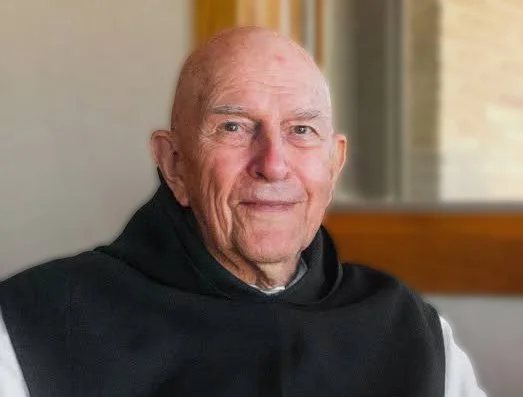
Trappist monk Thomas Keating.
Trappist monk Thomas Keating (1923 – 2018) discerned the need to express the Christian mystical tradition in the language of contemporary psychology, and to succinctly describe a Christian practice in a way that other world religions were doing for contemporary western seekers. This resulted in an insightful understanding of the human condition and how we can open ourselves to the grace of God, the ‘Divine Therapist’, healing deep into our wounded unconscious. And it was the origin of the widely used meditation practice known as Centering Prayer. Fr Grant Bullen - Anglican priest, spiritual director, retreat leader and teacher - reflects on how Keating has been a source of Living Water in his life and ministry.
I am not a scholar, and I am not an expert on Thomas Keating, but reflecting on how his teaching has been a source of Living Water in my life is something I can do.
Why choose Thomas Keating? Well, I’ve never found it easy to directly access the classical texts of Christian mysticism. I listen to people speak of their ‘instant connection’, like Jim Finley taking John of the Cross out into the monastery woods as a young novice, and feeling an instant attraction to the words on the page, even if he didn’t understand them.
I hear people speak like that, but I have to confess, that’s not my experience.
Still, to this day, when I go direct to the classic texts, I find myself lost ... so lost that I rarely feel attraction. I’m totally dependent on contemporary commentators, to take what is unintelligible to me and bring it into the light.
So, I’ve primarily been fed by the contemplative teachers of our generation.
And there are a number who I could have reflected on, for we are richly blessed.
In a century or two, when people look back on the Christian faith in our age, I think they’ll note with wonder how in a time when the institutional Church has been so lost and moribund such rich contemplative teaching has emerged.
When does the contemplative life begin? I remember long solitary walks along the beach in my childhood, feeling ‘something’ big and wonderful speaking to me.
I remember the day a monk from St Michael’s priory preached in my parish church, and the powerful attraction. In my late teens, I had no idea what I’d heard, but I knew it was different from the usual Sunday-by-Sunday diet, and that it smelled to me of Gospel and LIFE.
I remember in 1980, the English monk Mark Gibbard (SJE) throwing aside his intended addresses, and instead teaching us clergy, how to make a retreat. I remember how fortunate I was in the wilderness of the early decades as a parish priest, to stumble across the encouragement of good spiritual direction.
I look back and can see that although I didn’t understand it, and couldn’t name it, things were happening. But it was only in my late 40’s that I consciously chose the contemplative path. The moment I remember, was the larger-than-life Franciscan, Richard Rohr, speaking in a public lecture in Melbourne, 2005.
A gifted orator at the peak of his powers back then - a preacher more than a lecturer.
And he was throwing down the gauntlet, speaking with a confronting directness, perhaps echoing theologian, Karl Rahner, with his own version of ‘If the Church is to have a future it will have to be contemplative.’
I heard it as an authentic prophecy and as a personal call, a confirmation of all that had been before, and I went home and made a vow that was simply YES: this is the path I will follow.
But... what to do? I was a priest of 25 plus years by then, with the appropriate degree in theology to accompany it of course. But when it came to walking the contemplative way, I had no idea. There was a strong attraction, with accompanying dreams and romantic feelings of warm fuzzy vagueness, but as to what to do, I had no idea.
Grace supplied the way. With John Stewart as my spiritual director at the time, of course the thing to do was join his Living Well programme in Melbourne. And there, waiting for me, was a wonderfully eccentric and passionate teacher called Christina Fox.
Christina taught in an old-fashioned didactic way – reading from lengthy lecture notes (supplied), accompanied by reams of photocopied articles. As a refugee from the tyranny of discussion groups sharing mutual ignorances, I loved it! As a parish priest dying in the petty machinery of institutional life, I read every word she provided ... hungry, parched. And here I met Thomas Keating. At the time I had no idea that Keating had given himself to ministry for someone just like me - someone who had no idea what to do.
I love the story he tells: How it was back in the 1970’s, when he was abbot of St. Joseph’s Trappist monastery in Massachusetts. Just down the road, a Catholic retreat house had closed and been sold to a Buddhist group. When it reopened as the Insight Meditation Centre (teaching Vipassana meditation), Keating enviously watched the flow of young people attending their retreats, often knocking on the door of the more obvious monastery, asking directions how to get to the Buddhist centre.
Disheartened but intrigued, he began to engage these young seekers in conversation – what was it they were looking for at the Buddhist centre? In the ‘hippy’ vernacular of the time, the common response was, “A path, man! We’re seeking a path!” Given that most of them had been raised Christian, Keating asked why they didn’t search for a spiritual path in their own tradition, to which the reply inevitably was an astonished, “You mean Christianity has a path?”
This kept happening to him in the inter-religious dialogue that followed the Vatican II reforms. Over and over again, he saw that young people were not finding the depth of spirituality they were looking for in the Christian Church, and were being fed instead by Eastern teachers, many of them Buddhist.
Quoting him directly, he said:
“These kids were saying, ‘Here’s our method of meditation... what’s yours?’ And there was no answer, at least not with the same degree of wisdom and concreteness.”
In 2005, I was lost, looking across the fence longingly at the concrete practical teaching my Buddhist friends were getting. So, when I bumped into Thomas Keating, I was excited, and grateful.
Keating challenged his community to put the experience of the Christian mystical tradition into a simple formula that could be made available to people living ordinary (non-monastic) lives.
If I’m reading the chronology correctly, first came the method – Centering Prayer - a distillation of Christian meditational practice drawn from The Cloud of Unknowing.
Then, in expanding lifestyle and practice to accompany the Prayer, Keating developed a body of teaching that brought “contemporary psychology into dialogue with the classic Christian spiritual masters.” It is this expression of the traditional mystical paradigm in the language of our time, that I am very grateful for.
I found his articulation of the Human Condition compelling. For it was not just that I didn’t know what to do, I didn’t know where I was. Keating provided a narrative that enabled me to locate myself and to hear where I was being invited ‘next’.
He was more a speaker, a teacher, than an academic writer – indeed most of his published ‘books’ are the collection of originally oral presentations. And not being academically educated in the psychological sciences, he presented an ‘entry level’ understanding of human development, a narrative commonly understood in late 20th century western society, with the addition of his own gently humorous flair, all in dialogue with orthodox Christian faith and spirituality.
Ever since Freud and Jung, we’ve known that our behaviour is motivated and fuelled from the hidden world of the unconscious. Keating dives straight in, and claims this is what Paul expresses so eloquently in Romans (7.15-24) when he says:
“I really want to do what is right, but I can’t. I do what I don’t want to do – what I hate ...
I love to do God’s will ... but there is something deep within me, in my lower nature, that makes me a slave to sin ... Oh, what a terrible predicament I am in!”
In a typically clever, almost whimsical turn of phrase, Keating says this stuck-ness comes from our hidden ‘programs for happiness’ – the deep attachment strategies we form in early childhood in response to the inevitably unmet needs for security/survival, affection/esteem, and power/control.
In pursuit of these programs of self-salvation, we construct the False Self, that illusory identity, (previously named by Thomas Merton), that compels us to a life of impotent striving. All of which fails, because no thing can ever satisfy us, and which produces great suffering, not only in our own lives but for the people around us, and indeed the planet itself.
His writing, which is really his speaking, is littered with wry observations of how this False-Self motivation plays out, particularly in churches and religious communities, including in his own life. And I for one, easily found my own uncomfortable reality in that picture.
It’s a closed cycle of cause and effect, with emotional energy circling back to further feed and entrench the unconscious programs and narratives. And we are stuck. Keating says this is the Human Condition, traditionally described in the language of The Fall and Original Sin. Without dramatic intervention we are hopelessly stuck!
And so, enter the ‘Divine Therapist’, as Keating calls God. Primarily informed by John of the Cross’s understanding of the Dark Night, Keating describes how God intervenes, slowly but surely unmasking and dissolving the False Self, and detaching us from those tyrannical Programs for Happiness. Opening space for the True Self to emerge, the created self who yearns to be drawn into union with God.
There is a natural growth in consciousness – dependent on our consent and co-operation – that comes both in the movement of human maturing, and more dramatically through the direct light of Christ and the Gospel. Where we were once blind, we are given eyes to see. And with sight, there is new understanding and new possibilities to choose differently.
BUT ... there is the need for much more than insight, and here the most precious gift of Keating’s teaching comes into play. Only the direct healing touch of God can reach and transform the deepest human wounds, hidden in our unconscious.
As described below, Keating teaches the purification of the unconscious, achieved by the action of God, bringing transformative healing through the process of contemplative prayer:
In the deep rest of contemplative prayer
the human body receives permission, so to speak,
to evacuate the emotional junk of a lifetime.
In other words, we have a psychological tummy
filled with emotional traumas.
We are like persons sitting for ten, twenty, thirty, or forty years
on a meal we never digested….
What we need to do to heal our psychological indigestion
is a thorough evacuation of the emotional trauma itself.
That requires a willingness to feel the primitive emotions
of grief, fear, panic, despair,
or whatever emotions accompanied
the traumatic events of early life.
In the purification of the unconscious
this healing takes place through the process
of contemplative prayer.
Contemplative prayer gradually brings about
the liberation of whatever prevents the presence of God
from becoming a part of our conscious awareness.
(from ‘The Better Part’, by Thomas Keating)
As I move further into the precarity of old age, I am in awe of how deep these unconscious wounds live within, and my only hope is that as Thomas promises, God can indeed reach there ... and heal.
For many years I saw Mary of Bethany sitting at Jesus’ feet, listening to the teaching flowing from Christ’s lips. It was Thomas Keating who showed me a deeper truth – that Mary is actually just sitting, open and undefended, bathing in the Divine Light, that reaches deep into her wounded depths.
I still love insight when it comes, and where I can choose differently, well, ‘bring it on’. But the main game now is to sit in that Divinely Therapeutic presence, as openly as I can.
I’m a ‘child’ when it comes to understanding the practice of meditation, but there is something powerfully efficacious in the surrender method of Centering Prayer.
Cynthia Bourgeault, in her 2024 book, Thomas Keating: The Making of a Modern Mystic, argues that Keating had moved on by his death to a new and different stage of “No Self” beyond the True Self of his earlier teaching.
She makes a convincing argument. And she sounds perhaps a little peeved that people still want to dwell on his earlier work, where she is eager to move on to these deeper more mysterious waters. I understand, and indeed maybe that is what comes next. But I for one, am very glad Thomas Keating didn’t go there too quickly …
I am very grateful to Thomas Keating and the company of wise contemplative teachers of our time. God is merciful, and we are richly blessed.
This article is based on an online talk that Fr Bullen gave at The Well on 8 November. A recording is available here: Use Passcode: 8akke.E! https://us02web.zoom.us/rec/share/ln1oEtthVns_FeIfcx3lSI38LGV-EzQLxyT0K7bWcCOw3VVJ204Sl8NgSeq-DVX8.Y3_O-X3uuyoeaLe2