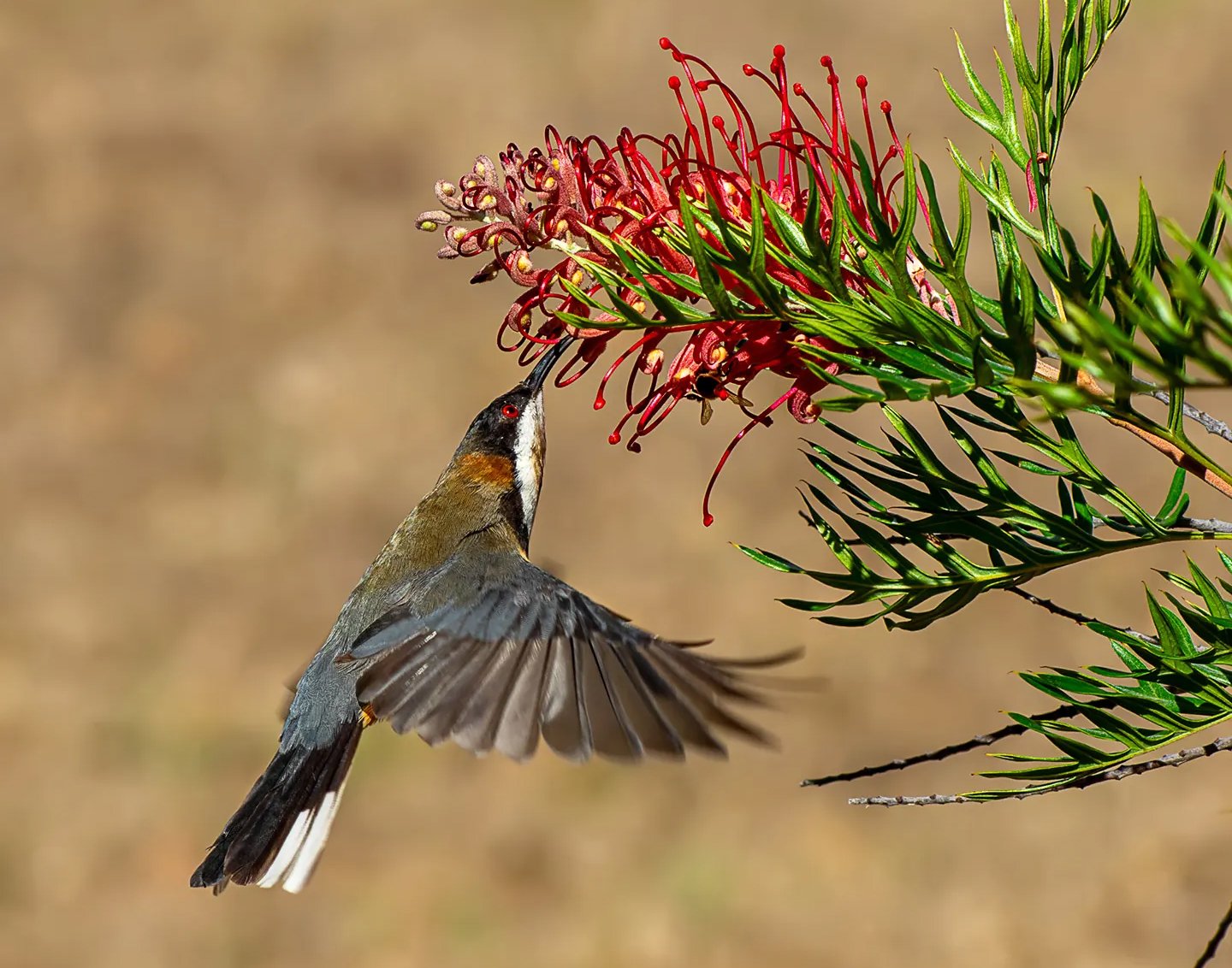
An Eastern Spinebill feeding on a Grevillea
Perhaps angels and birds have more in common than we think, writes Roland Ashby, contributing editor of Living Water. Birds, and nature more generally, can be divine messengers, he says, if we are open and receptive enough to hear the message.
Dear God,
We give thanks for birds. All types of birds. Small birds and large birds. Domestic fowls, migratory birds and birds of prey, hooting birds, whistling birds, shrikes, coloured parrots and dark darting wrens. Birds too numerous to mention …
We give thanks for eggs and feathers, for brave, cheerful songs in the morning and the wonderful, haunting night prayers of owls and all nocturnal fowls.
We praise the character of birds, their constancy, their desire for freedom, their flair for music and talent for flying. May we always marvel at their ability to fly …
Dear God, guide our thoughts to the joy and beauty of birds. Feathered angels. May they always be above us.[1]
Amen.
In Fra Angelico’s magnificent painting The Annunciation, it’s a bird, a dove – representing the Holy Spirit in the beam of light - that announces the moment of Immaculate Conception. (See: https://www.thelivingwater.com.au/blog/advent-calls-us-to-bring-jesus-to-birth-within-ourselves) And if you look closely just above Mary to the left, you’ll notice a very still House Martin looking on, almost perhaps a mirror of the Virgin. And as Sister Wendy Beckett points out, the tips of the Archangel’s wings and a single foot protrude into the wild world of nature, suggesting that “Nature and the supernatural are not, after all, as separate as they appear”.[2]
Birds also have a significant place in the Bible, and it is the dove of course that symbolises the Holy Spirit, most significantly at the baptism of Jesus and start of his ministry. This has led me to ponder, given that wings and flight are characteristics of angels and birds, that perhaps angels and birds have more in common than we think.
It’s with all this in mind, together with Michael Leunig’s prayer, that I started to perceive a daily visitor to my garden, an Eastern Spinebill, in a totally different way - as my own angel of annunciation, announcing the moment of divine conception within me, and the birth of divine perception.
It was in this moment each day during my morning prayer as I gazed through the window at the bird attending to the Grevillea Bush, that my perception was transfigured, and consciousness so expanded that I could now get a glimpse of understanding into what Meister Eckhart meant when he said:
“The eye with which I see God is the same eye with which God sees me.”
And it’s with this eye that we are able to perceive birds and nature as a mirror of the divine beauty.
It is also significant I believe that the change of perception occurred after meditation, in which John Main tells us that by learning to say the mantra with faith and attention we open our hearts and minds to the possibility of becoming one with the infinitely expanding consciousness of Christ, the pure consciousness of love, which is what Jesus meant by ‘purity of heart’, when he said, “Blessed are the pure in heart, for they shall see God”. (Mat.5:8)
This also reminds me of the famous quote by William Blake, that “If the doors of perception were cleansed everything would appear … as it is, infinite.”
I was so inspired by my daily angelic visitor that I wrote a poem:
Annunciation
There’s a reason angels are depicted with wings.
My angel joins me for prayer each morning –
an Eastern Spinebill lured by a Grevillea,
its blood-red blooms all aflame -
like me, in search of honeydew.
A master of flight, elusive,
in her dance with gravity,
now wheeling,
now darting,
now reeling,
now diving,
at times held in a miracle of stillness,
mid-air
her wings a paradox of suspended motion
as she attends the burning bush.
There’s a reason angels are depicted with wings.
In July I went on a pilgrimage to Uluru, a great rock that rises majestically out of the desert in central Australia, and a site sacred to Indigenous Australians.
While stopping by a waterhole at the base of the rock, again something magical happened. In a moment of pure transcendence, a Willy Wagtail sang to us. I describe this moment in the following poem:
Divine Messenger
By a waterhole at Uluru
A Willy Wagtail sang
a song primordial,
yet ever new.
Time blinked in wonder.
For generation upon generation its songline
calling us,
calling us back
to a time before the fall,
before the ghost men came
with axe, and gun, and Bible.
I have found that other birds too can powerfully symbolise the movement of the Spirit. While I was on a silent retreat at the Anglican Benedictine Monastery of St Mark’s in Camperdown, Victoria, Australia, I was inspired by a pair of Harrier Hawks circling at twilight to write the following:
The aerodynamics of grace
With heart’s wings outstretched
I ride the air streams
of your love
neither prey, nor preying upon,
trusting, for a moment,
in the aerodynamics of grace
against the dead weight
of all desires
and delighting
in the joy of it.
Free fall
Where you go
I must follow.
At this edge of night
school me in the ways of flight
with sinew taut
and power of one,
single,
undiluted thought.
But, most of all,
on nearing home,
teach me the art
of
free
fall
One of the greatest theologians of the Church, St Thomas Aquinas, famously said that “Revelation comes in two volumes, nature and the Bible”. God is manifested in both the world of nature and the sacred scriptures.
St Francis of Assisi understood this. There is the beautiful story of him looking at the Almond tree in winter and asking it to speak to him of God, and the tree instantly blossomed. He viewed all elements of the natural world as creations of God, to be treated with respect, love, and care. For Francis, nature was a mirror of God's beauty and goodness, and he often referred to birds, animals, plants, and the elements as his "brothers" and "sisters." Giotto’s famous painting of Francis preaching to the birds, beautifully captures this kinship with nature that Francis felt.
Francis believed that all of creation was inherently good, as it was made by God. He saw the natural world as a reflection of God’s divine presence.
St. Irenaeus said the glory of God is the human being fully alive. And that to be fully alive is to behold God. And St. Francis believed that we could behold God in all that is created.
Indigenous peoples have understood this too. In Australia, the Aboriginal practice of Dadirri, is a deeply contemplative way of becoming aware of the divine presence in nature, and in our lives more generally.
Indigenous elder and teacher Dr Miriam-Rose Ungunmerr-Baumann, who is also a Christian, describes Dadirri as “inner, deep listening and quiet, still awareness”.
This is a process that Franciscan Friar Dan Riley would describe as Franciscan Lectio Divina. “God’s face, St Francis believed, shone from within all that was created.”
“The Franciscan disposition” he says, “is that the reign of God is always at hand; the richness of God’s glory is present here and everywhere … [Franciscan] Lectio is about reading or focusing or listening long enough and deeply enough so that beauty, depth and connectivity emerge …
“Franciscan Lectio is a practice in which you begin to actualize your connectedness with everything – your inherent and inherited union with the Divine … [and] Eventually a new light comes on as we are brought into unity. We open our hearts to the conversion that is part of the habit and practice of Lectio – a conversion through reading the sacred cosmos: the Christ that is in everyone and everything.”[3]
St Augustine famously defined a sacrament as a visible and outward sign of an invisible and inner grace, something which can be applied to nature too. Indeed, John Chryssavgis, in The World of the Icon, writes that “everything is in some way sacramental. It all depends on the receptiveness and openness of our hearts.”
And Benedictine Abbess and artist Christine Valters Paintner says that “the more we cultivate intimacy with the natural world, the more we discover about God’s presence. All of our interactions with nature can be sacramental, and all the ways nature extends herself to us are sacramental as well.”
She adds: “There is a sense of God’s incarnate presence in creation that shimmers forth to reveal the holiness of all things. Notice how your senses come alive when you walk out in the world aware of its sacramental nature. What do your eyes, ears, nose, mouth, and skin each reveal to you about how God is alive in the world around you?”[4]
Franciscan priest Richard Rohr says that all we have to do “is walk outside and gaze at one leaf, long and lovingly, until we know, really know, that this leaf is a participation in the eternal being of God. It’s enough to create ecstasy! Our relationship to reality allows us to meet things centre to centre or subject to subject, inner dignity to inner dignity. For a true contemplative, a gratuitously falling green leaf will awaken awe and wonder …”[5]
Finally, I would like to introduce you to two ways of contemplation in nature: sitting contemplation and walking contemplation.
In both cases the key to the practice, as indeed to all contemplative practice, is to take your time, to slow down, to keep silent, and to adopt a “Beginner’s Mind”, so that you can experience whatever you perceive like a very young child, without labels, preconceptions and judgements, and to notice things – as if for the first time. Jesus said we cannot enter the Kingdom of Heaven unless we become like little children again.
Sitting contemplation in nature
The following description of this practice has been partially inspired by the words of Miriam-Rose Ungunmerr-Baumann:
Clear a little space as often as you can, to simply sit and look at and listen to the earth and environment that surrounds you.
Focus on something specific, such as a bird, a blade of grass, a clump of soil, cracked earth, a flower, bush or leaf, a cloud in the sky or a body of water (sea, river, lake...) whatever you can see. Or just let something find you, be it a leaf, the sound of a bird, the feel of the breeze, the light on a tree trunk. No need to try. Just wait a while and let something find you, let it spend time with you. Lie on the earth, the grass, some place. Get to know that little place and let it get to know you - your warmth, feel your pulse, hear your heartbeat, know your breathing…Simply be aware of your focus, allowing yourself to be still and silent... to listen... [6]
Contemplative walking
In the book of Jeremiah, God asks, “Do I not fill heaven and earth?’ (Jeremiah 23:24). Contemplative walking in nature is an opportunity to experience that truth.
I invite you now to imagine you are on a contemplative walk. Imagine that you are now standing in your garden, park, or favourite walking track and, standing still, with arms by your side, begin to breathe slowly and deeply in and out through the nose.
Repeat several times, and enjoy and delight in the simple act of breathing, relaxing, and resting in the present moment, and give thanks to God for the wonder, beauty and blessing of breath and life.
As you very slowly and deliberately begin to walk, ask God to so awaken your senses that you will be able to give thanks for the wonder and beauty of creation. Move slowly, and pause regularly, to receive the gift and blessing of each moment.
Try to give your pure attention to whatever your senses are perceiving in the present moment. So that whenever you look, or listen, or touch, or smell, you do so with undivided attention.
Savour and delight in whatever your senses are drawn to - a cool, refreshing breeze; the texture, shape and patterns of bark or a leaf; the whisper of a breeze and rustling of leaves; the colour, shape and fragrance of a flower; birdsong; the play of light and shade.
Christine Valters Paintner says, “As you walk, bring your full presence and attention to each step. Allow your breath to be full and deep. Listen and Look. Notice if there is something shimmering and calling for your deeper attention. Perhaps it is a leaf or flower, the bark of a tree or a wide-open vista.
Slow yourself down even more and simply linger with this landscape or object in nature that has become your word or phrase [as in Lectio Divina].”[7]
Give thanks to God for what you have received, for all your senses and for the wonder, beauty and blessing of all creation.
I would like to finish with my poem In gratitude for Trees:
In gratitude for trees
It was no accident
that the Buddha
received enlightenment
under the Bodhi tree.
Or that Christ
was nailed to a tree,
his final transfiguration.
Trees -
you were here
long before us.
We have breathed you,
unseeing guests
at life’s feast.
Teach us now
your slow ways
so that,
in stillness,
and silence,
our hearts too
may run deep,
and our spirits
dance
in the light.
As Christmas approaches, may we, like Mary, be God-bearers, but may we also be open to seeing others – and the beauty and wonder of nature – as bearing God to us.
This article is based on a talk that Roland gave on 15 December at Benedict’s Well, an outreach of the oblates of the World Community for Christian Meditation. See: https://www.youtube.com/live/vrMJEKoWtwo?si=wOjvXqyNnNhOl2Un
References:
[1] Part of a prayer by Michael Leunig, from When I talk to you (HarperCollins)
[2] Sister Wendy Beckett, Sister Wendy’s 1000 Masterpieces (Dorling Kindersley 1999) 12
[3] Dan Riley, Franciscan Lectio: Reading the World through the Living Word (Paraclete Press 2022)
[4] Christine Valters Paintner, Earth, Our Original Monastery, Cultivating Wonder and Gratitude through Intimacy with Nature (Sorin Books, 2020)
[5] Adapted from Richard Rohr, A New Cosmology: Nature as the First Bible (CAC Publishing, 2009)
[6] Dadirri – A reflection by Dr Miriam-Rose Ungunmerr-Baumann (Emmaus Productions 2002)
[7] Christine Valters Paintner, Lectio Divina – The Sacred Art (SPCK 2012)