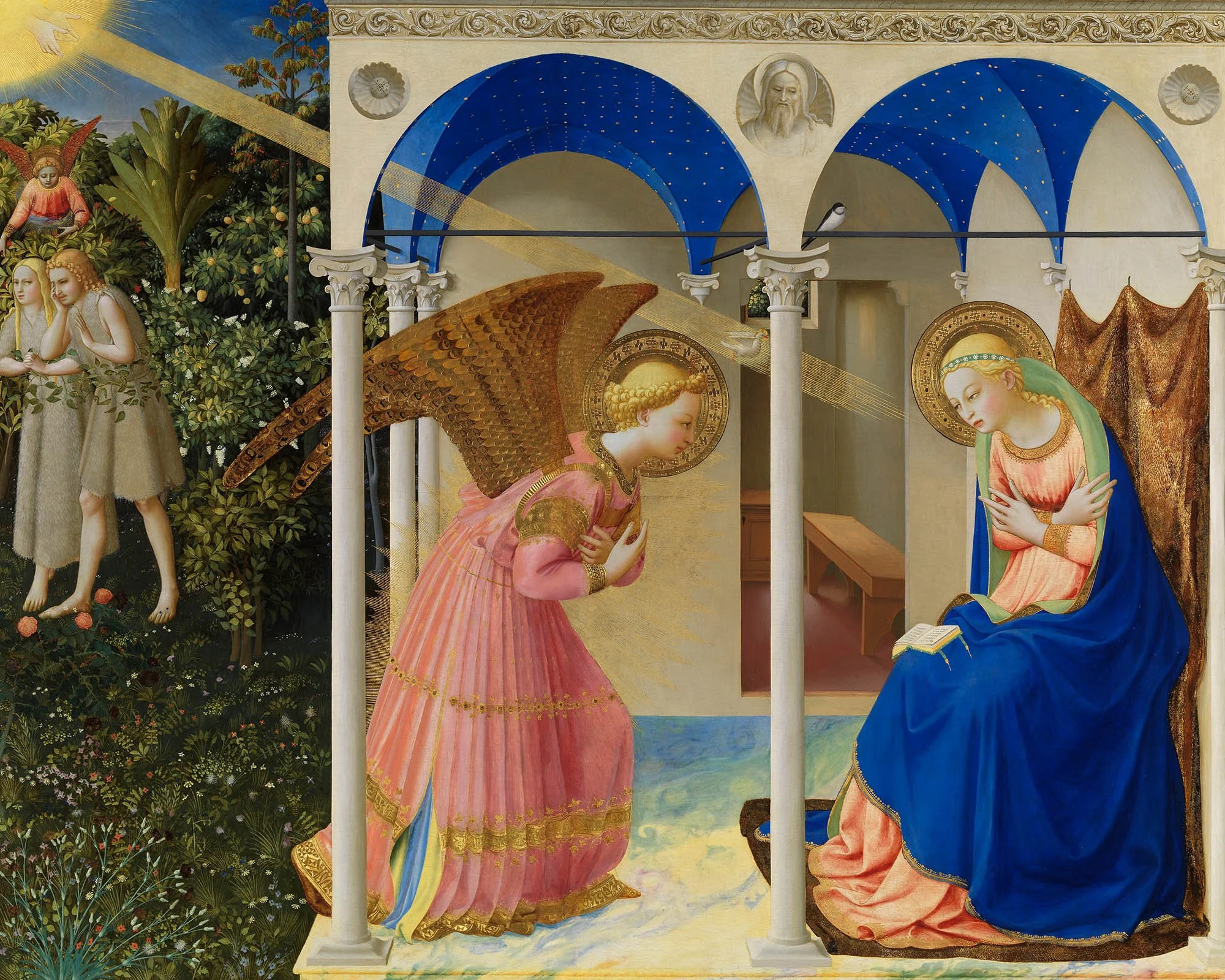
Fra Angelico’s painting of the Annunciation.
We must discover our true inner harmony and the source of our being if we are to avoid being overtaken by anger, hatred and fear. Dr Sarah Bachelard, author and founding director of Benedictus Contemplative Church in Canberra, Australia, reflects on what Luke 1:26-38, ‘A virgin shall conceive’, can teach us about the spiritual crisis of our time.
26 In the sixth month the angel Gabriel was sent by God to a town in Galilee called Nazareth, 27 to a virgin engaged to a man whose name was Joseph, of the house of David. The virgin’s name was Mary. 28 And he came to her and said, ‘Greetings, favoured one! The Lord is with you.’[a] 29 But she was much perplexed by his words and pondered what sort of greeting this might be. 30 The angel said to her, ‘Do not be afraid, Mary, for you have found favour with God. 31 And now, you will conceive in your womb and bear a son, and you will name him Jesus. 32 He will be great, and will be called the Son of the Most High, and the Lord God will give to him the throne of his ancestor David. 33 He will reign over the house of Jacob for ever, and of his kingdom there will be no end.’ 34 Mary said to the angel, ‘How can this be, since I am a virgin?’[b] 35 The angel said to her, ‘The Holy Spirit will come upon you, and the power of the Most High will overshadow you; therefore the child to be born[c] will be holy; he will be called Son of God. 36 And now, your relative Elizabeth in her old age has also conceived a son; and this is the sixth month for her who was said to be barren. 37 For nothing will be impossible with God.’ 38 Then Mary said, ‘Here am I, the servant of the Lord; let it be with me according to your word.’ Then the angel departed from her. (Luke 1:26-38)
Advent is traditionally understood as a season of impending crisis. All those texts about the judgement to come, those calls to repent and change. I think there’s a sense in which this season of Advent speaks especially powerfully in our contemporary situation. For we seem to be undergoing a prolonged crisis in relation to almost every facet of our existence – ecological, economic, political, ecclesial. Like those in first century Judea, we too are living under judgement; aware of the unsustainability, indeed the corruption, of much of our common life. As a consequence, a sense of vulnerability, anxiety and powerlessness are pervasive.
At one level, I think this sense of crisis is a good thing. It’s a wake up call – which is also what this season is about: ‘sleeper awake’. But it’s also dangerous. For when people experience themselves facing an uncertain future, when they’re disillusioned with the status quo and unable to see a way forward, there is fruitful ground for the escalation of fear, anger, frustration and blame. In some cases, this anger and fear are mobilised and misdirected towards the even more vulnerable ‘other’, the ‘outsider’. In such contexts, public discourse is often polarised and weaponized, while those attempting nuanced engagement with complexity are squeezed out and silenced.
A few years ago, during the Covid crisis, I was involved through the World Community for Christian Meditation in a conversation about just these dangers and divisions in a time of crisis. One of the others involved was Herman van Rompuy, a Belgian politician who served as Prime Minister there from 2008–09, and was later the first permanent president of the European Council (2010–14). He talked about the polarising of politics and rise of populism that threatens many societies at their root in these uncertain times. He touched on some of the underlying social causes of this polarisation, but he also raised the question of the spiritual dimension of our collective crisis.
‘Why’, he asked, ‘is there so much inner dissatisfaction, which is then politically translated into aggression?’ Does it have to do with the hyper-competitiveness of our society? Is it connected with excessive individualism which brings disconnection from others and lack of empathy? Or, he asked, does it have to do with the superficiality of much our life – a life focused on activity and pleasure-seeking with little listening, self-interrogation, or recognition of our fundamental dependency. Are we suffering collectively, he wondered, from the lack of interiority as a counterforce against anger and impatience? ‘Living together’, he said, is based on the sharing of values and of common destiny, but those values must also have an inner foundation if they are to withstand storms. They need to be interiorated’.[1]
Well – I’m aware this seems a long way from the angel Gabriel visiting a virgin whose name was Mary, but I was reminded of this conversation by our text. For Mary has traditionally been a symbol of radical and fruitful interiority. And I’m interested in what she offers in relation to this spiritual crisis of our culture. In particular, I want to explore what might be gleaned from the significance of Mary’s virginity in the Christmas story.
This may seem an unpromising and indeed, politically incorrect, place to start. So here’s what I think the insistence on her virginity is not about. It’s not essentially about the mechanics of Jesus’ conception. At least, not in an obvious biological sense. In the Scriptural imagination, the virginity of Mary, like the barrenness of Sarah and Hannah and Elizabeth, is a sign that what’s being given and what is to happen in and through this child of promise is God’s doing, not ours. Again and again, in the story of Israel, where the way (the womb) had seemed closed, where impossibility had reigned, God remains free to act so as to create new life. The overshadowing of Mary by the Holy Spirit is thus meant to evoke, not a creepy sense of male domination, but the hovering of the Spirit over the waters at the creation of the world itself. ‘Creation occurs’, writes theologian Ben Myers, ‘when the Spirit of God broods over the formless abyss and brings forth life out of nothing’.[2]
Now I know this imagery has been taken up by our tradition in troubling ways. When combined with Aristotelian biology and a vision of God as male, for example, it’s contributed to an understanding of women as providing only ‘formless matter’ in procreation, with all the form and animating energy coming from the male. When combined with gnostic teaching on the evils of the flesh, Mary’s ‘virginity’ has contributed to a centuries’ long ambivalence in Christianity about sexuality and the body, and about women’s sexuality and bodies especially. As feminist critics have pointed out, in the hands of a patriarchal church, Mary became the measure by which all other women were pre-destined to fail. For what real woman could live as both virgin and mother? In the light of this oppressive and distorting history, retrieving her meaning for us is quite a task.
Nevertheless, what I love about the figure of Mary is that though she gives herself without remainder to what God will do in and through her, she’s not some passive vessel. She is always actively engaged – inquiring, consenting, reflecting on meaning, striving to integrate her experience with her understanding. In her encounter with the angel, she is said to be much perplexed and to have pondered what sort of greeting this might be. After Jesus’ birth, when the shepherds visit the holy family in the stable and report what they’d been told of the child by angels, Mary is said to have ‘treasured all these words and pondered them in her heart’ (Luke 2.19) And again, some years later, when the child Jesus frightened his parents by staying behind in Jerusalem after a festival, explaining that he ‘must be at [the Temple] his Father’s house’, Luke writes that ‘they did not understand what he said to them’ but that ‘his mother treasured all these things in her heart’ (Luke 2.51).
Mary, in other words, is depicted as having a rich inner life, a reflective capacity, an interiority. In mediaeval iconography she is often portrayed in an enclosed garden, solitary, reading a book (maybe that’s why I like her!!). And I wonder if it’s this that constitutes the deepest meaning of her virginity. Because although she’s humble and available, receptive and other-centred, she’s never colonized or determined by events. ‘My will my own; My word to give or withhold’ as poet Nicola Slee imagines her.[3] The early church theologian Gregory of Nyssa wrote a treatise called ‘On Virginity’, in which he understands virginity essentially as incorruptibility – a state of being to which the married as well as the celibate must aspire.[4] Incorruptibility in the sense of healthy detachment, non-attachment, purity of heart. Mary is not swayed by what people think of her; she doesn’t grasp at power or influence; she remains self-possessed even as she is dispossessed, being and becoming herself in relation to God, more and more fully integrated over the years.
John Main said that to our era, in need of rediscovering ‘an inner life that has been largely dissipated in materialistic systems of thought and of society … Mary is above all the symbol of a rich, healthy and creative interiority’.[5] This is the condition of her conceiving God’s word, God’s life and bringing it to birth bodily; it’s the condition of her becoming capable of bearing what she must bear at the foot of her son’s cross. And John Main goes on: ‘the most powerful aspect of her meaning for people today … is the need for a true inner harmony … She shows the need for the resolution of the dissonant faculties in us, the transcendence of our sense of duality in relation to ourself and to God, the integration of Yin and Yang, the concentration of our spirit upon the source of our being’.[6]
I began by quoting Herman van Rompuy’s wondering if the polarisation of our society, the violent tone of so much public discourse is significantly to do with a lack of interiority, the lack of an inner foundation or integration ‘as a counterforce against anger and impatience’. I know it’s a cop out to personalise and spiritualise all social ills – to think that frustration at injustice or disempowerment can be cured merely by exhorting people to deepen their inner life. But equally, I think it’s deluded to imagine that the crisis of our culture can be healed purely by social, political or economic reform. We can, as people and as societies, get into habits of reactivity, impatience, mercilessness; we can give ourselves permission always to blame someone else for our behaviour, rather than doing the inner work necessary to integrate and transform our pain, our limits and our own shadow. We can be immature and a society that offers no real context for spiritual formation and growth is bound to be. Van Rompuy’s insight is, I think, that a widespread lack of interiority, of spiritual maturity, increases people’s susceptibility to being overtaken by anger, hatred and fear. And this, in turn, profoundly increases our vulnerability to manipulation, to being exploited and persuaded by cynics and tyrants to conspire in our own and others’ diminishment.
At the turning of the age, in the New Testament’s understanding, it was a virgin who conceived and bore God’s son, God’s meaning on earth. Someone who was recollected and pure of heart, integrated and so interiorly fruitful. The early Christian fathers and mothers understood Mary as a model for their own pilgrimage and for the vocation of the church itself. ‘In Mary they saw the reflection, indeed the ideal, of their own experience ... because they knew that every Christian, every responsive heart, is called to bring Jesus to birth within him or her’.[7] This is our vocation too, as persons and as a community, for the love of the whole. ‘So God imparts to human hearts, the blessings of His heaven. No ear may hear his coming, but in this world of sin, where meek souls will receive Him still, the dear Christ enters in’.
Dr Sarah Bachelard is a theologian, retreat leader and founding director of Benedictus Contemplative Church in Canberra, Australia. See https://benedictus.com.au/
Her books include Experiencing God in a Time of Crisis, Poetica Divina: Poems to Redeem a Prose World and Pools of Grace: The Gift and Call of Contemplative Worship (forthcoming).
This article is based on a talk she gave on 8 December to Benedict’s Well, an outreach of the oblates of the WCCM. You can view the recording here: https://www.youtube.com/live/_QIXBIkgy_I?si=-AKlkOZaMiUTVwYv
References:
[1] See ‘A Conversation with Herman van Rompuy’, https://acontemplativepath-wccm.org/the-contemplative-conscious-mind-a-conversation-with-herman-von-rompoy/
[2] Ben Myers, The Apostles’ Creed: A Guide to the Ancient Catechism (Bellingham, WA: Lexham Press, 2018), p.43.
[3] Nicola Slee, ‘Consent’ in The Book of Mary (New York: Morehouse Publishing, 2007), p.20.
[4] From the Preface, Gregory of Nyssa, ‘On Virginity’ https://www.documentacatholicaomnia.eu/03d/0330-0395,_Gregorius_Nyssenus,_De_virginitate_%5bSchaff%5d,_EN.pdf
[5] John Main, ‘The Other-centredness of Mary’ in Community of Love (New York: Continuum Publishing, 1999), p.164.
[6] Main, ‘The Other-centredness of Mary’, p.172.
[7] Main, ‘The Other-centredness of Mary’, p.165.