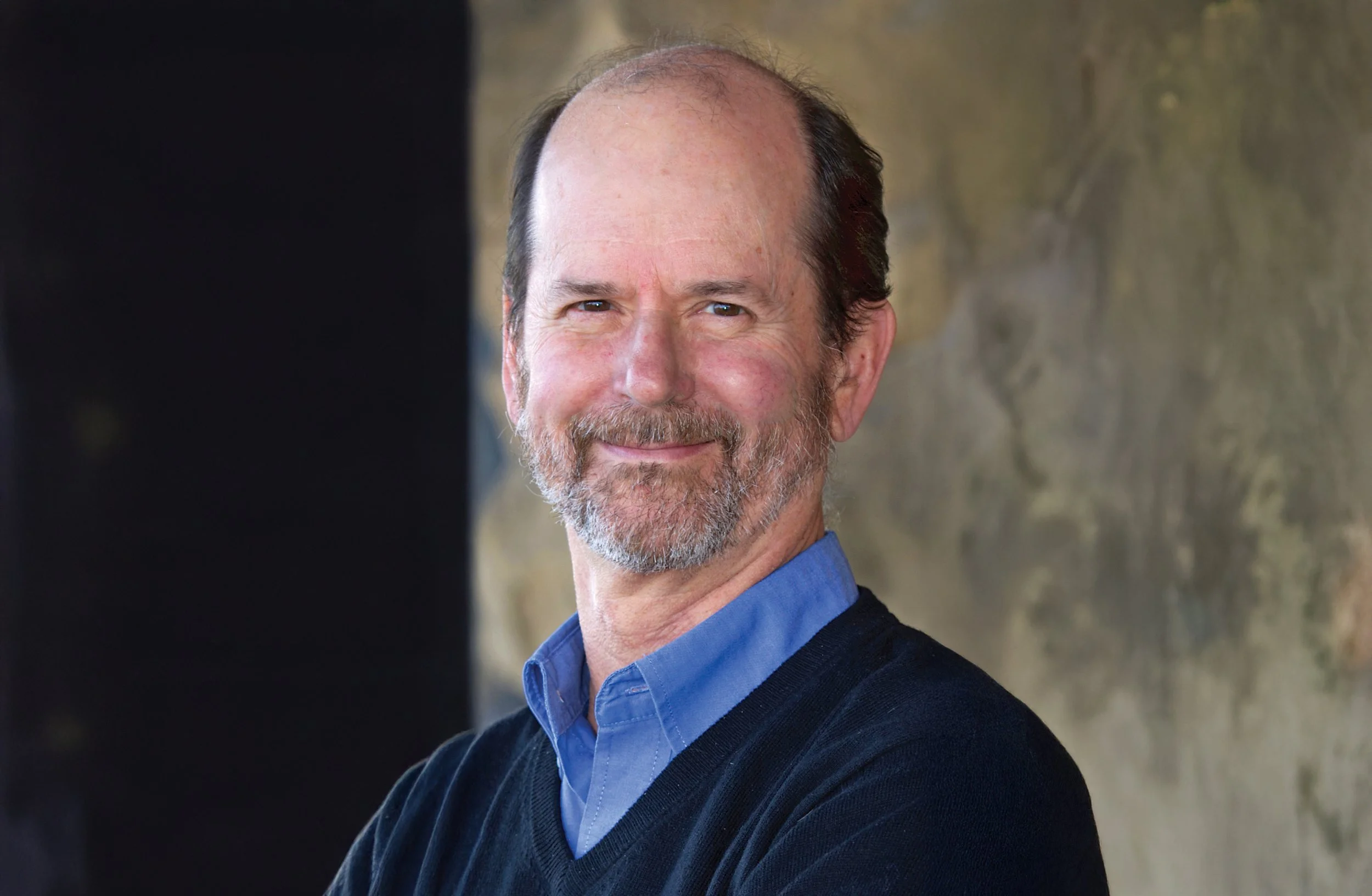
Eckhart scholar Dr Mark S. Burrows.
14th century German mystic Meister Eckhart believed the path to God is a “wayless way” in which we let go of all that we know about God. Scholar, poet and translator Dr Mark S. Burrows* reflects on how this way of unknowing leads to the joy of discovering freedom within, from which God shines forth, and shines out “in all things”.
If I were to choose one word to convey the heart of Eckhart’s thought, it would be this peculiar word that he coined: “Abgeschiedenheit.” It is sometimes rendered as “detachment,” but that is a bit misleading as it suggests a kind of agency. We might best render it, more expressively, as “solitude.” It is that experience of unboundedness, disjoined from the spiral of dependency on others. An inner freedom. A joyful way of being that is loosed from the bondage of expectations—others toward us, and ours toward ourselves (or others—including the one we call “God”).
How do we discover that inner freedom? This was a theme close to Eckhart’s heart, knowing as he did that our restlessness, our insatiable appetite for distractions—including the “distraction” of occupying ourselves with “God”—leaves us frustrated, exhausted, and often afraid. Meditation is not a solution to this as a problem, but it is an opening to another way of being.
In one of Meister Eckhart’s talks given to Dominican novices in Erfurt, he explored the question of “detachment” and what a true “possession” of God might be like. We could paraphrase this as a stance of serenity—or inner freedom—in the presence of God. What precedes this citation is his wondering how we can “truly have God” within us so that we are not constantly striving to find an external means—whether particular works, like devotional practices, or “sacred” places or particularly “holy” people—of experiencing God. How, in other words, can we live in the presence of God within us so that we are not looking outward for some crutch to help us “experience” God? His response:
Where do we experience this true possession of God—so that we really ‘have’ God? This true possession of God depends on the heart, that inner motion of the spirit toward [God], a striving toward God, not in a continuous and equal thinking of Him always and in the same way. For that would be beyond our human capacity, very difficult and, ultimately, not even the best thing to do. A person should not have, or be satisfied with, a ‘conceivable’ God, for then, when the thoughts [about God] vanish, we find that God [seems to] vanish. Rather, one should have a living God who far transcends the thought both of humans and of all creatures. Such a God never leaves us unless we willingly choose to turn away from God. (Meister Eckhart, from The Talks of Instruction, Ch. 6 [my translation])
Eckhart is quick to add to this that those who “find” God within their hearts, and not simply through thinking about God, or having particular “thoughts” about God, discover something startling. They discover God “shining out” to them “in all things,” such that everything “tastes”—yes, tastes—of God “and in all things it is God’s image that they see.”
Everything and in all things. What a claim this is! Our work, in other words, is not to have the right idea about God. We could never accomplish this, he is quick to say. Better to discover God within us, and our “being” within God, beyond thinking and feeling. Beyond the opinions and arguments we might have for (or against) God. All of this, he felt, was simply a needless distraction.
We would do well in times like ours to heed his wisdom. In recent decades, a movement that boldly called itself “the New Atheism” took hold in England—guided by a circle of scholars that includes Sam Harris, Richard Dawkins and Christopher Hitchins. The thrust of their thinking finds expression in Dawkins’ 2006 book The God Delusion. It offers a masterful dismantling of arguments for the existence of God which he (and others) found specious. Strangely, Eckhart (and other mystics like him) would have largely agreed with him, though he would have insisted that this “new Atheism” had not taken things far enough. No, the real work is to unlearn, to “un-know,” most of the conventional ways we have imagined God and spoken about Him (or Her).
This is what theologians have long known as the “apophatic” path. The path of renouncing what we only think we know, an “unknowing” that opens us to a mystery that cannot be “known” as we know other things. Eckhart’s “wayless way” into the One he sometimes calls “the wilderness.” Or “abyss.” Or “nothingness beyond being.”
In one of his celebrated “Sabbath” poems, the American poet Wendell Berry offered a glimpse of a person who lived by a sense of what Eckhart called “Abgeschiedenheit,” which is often translated as “detachment” but might be better rendered, in an experiential sense, as an entering into “nothingness.” “No-thing-ness.” Call it solitude. Or inner serenity. Berry put it this way, showing us what it might look like in a person:
I dream of a quiet man
who explains nothing and defends
nothing, but only knows
where the rarest wildflowers
are blooming, and who goes,
and finds that he is smiling
not by his own will.
[“Sabbaths 1999,” no. ii; in Given. Poems (2006)]
I’ve long loved this simple poem which captures what Eckhart meant by Abgeschiedenheit. This “quiet man” (or woman) is one not bent on defending him- or herself. Nor is she intent on explaining anything—an idea or viewpoint or opinion. No, this one has an inner “solitude” that frees them from the endless spiral of argument, that tendency to defend or explain—in order to prove ourselves right and others wrong. We seem to be suffering from an acute malady of this in the current political scene, at least in the United States. But it is often enough something we adhere to, often unintentionally, in our faith.
How might we live, differently? Well, this “quiet” person lives with attentiveness to the natural world, knowing where “the rarest wildflowers” bloom. And, in so doing, lives with an inner smile that does not depend on some form of psychological exertion or existential state of mind. Call it “Abgeschiedenheit.” Solitude. A sense of inner freedom from external or internal compulsions.
What a marvelous image this is! Some, of course, might find it ridiculous. Precious. Self-absorbed. That, of course, would miss Berry’s point altogether. That “quiet” person lives with such freedom that he or she knows to see something simple and singular—like the small “miracle” of beauty found in a rare wildflower. This is a person who has given up on arguing, defending, declaring, pronouncing. This is a person who lives with a serenity of heart.
Recall, for a moment, a scene found in each of the so-called synoptic Gospels (Matthew, Mark and Luke). In the latter, we come upon Jesus surrounded by a crowd of parents who had brought their infant children to him—presumably for a blessing. The disciples reason that this is beneath his dignity. They rebuke the adults, thinking that Jesus had more important things to do than be distracted by little children. He had other ideas, though, and rebukes them: “Let the children come to me, and do not hinder them, for the kingdom of God belongs to them. Truly I say to you, whoever does not receive the kingdom of God as a little child will never enter it” (Lk. 18. 15–17).
What is it that children have that prompted Jesus’ remarks that the “kingdom of God” belongs to them? Perhaps their sense of “Abgeschiedenheit,” of living in deeper solitude. Of living more freely. More spontaneously. More immediately, in our bodies as in our minds—in this world—than we adults often do. Perhaps he realized that their sense of openness of heart, of freedom of mind, opened them to see the world in the “simple and singular” ways it presents itself to us: in particular flowers; in the shifting play of clouds wandering across the horizon; in those moments of noticing little things—for the first time.
In one of his German sermons, Eckhart warns against assuming that we can cultivate some particular devotional practice—which he calls “an inner work”—by which we could control God. Or manage our spiritual reality. He put it this way:
A master [in the university] says: ‘Those who wish to achieve an inner work must gather all their powers and place them in a corner of their soul, hiding themselves from all images and forms; only then can they accomplish it. In the process they must enter into a forgetting and not-knowing. There must be a stillness and a keeping-silent if this word is to be heard. We cannot serve this word more faithfully than in stillness and keeping-silent, for only then can we hear and understand it aright: in that unknowing. Where we know nothing is where this word appears, revealing itself.
Unknowing. Releasing ourselves from the need to know. To defend or explain. To simply be, experiencing an inner freedom, a solitude of heart and mind. To take an apophatic stance toward what is, which is to say to open ourselves to “the real” beyond our hopes or fears, or desires or disdains.
How do we do this? By “forgetting” what we know or thought we needed to know. By opening ourselves to what we call, in the short prayer many of us use before beginning a period of meditation, the “silent presence” of God: “Loving God, open our hearts to the silent presence of the Spirit of Your Son. Lead us into that mysterious silence where Your love is revealed to all who call. Maranatha!”
How do we find our way into that “mysterious silence” in which God’s love is revealed to us? How do we come to journey on this “wayless way” into the mystery of the divine?
These are crucial questions. Eckhart thought the best thing we could do is to summon all of what we presume to be our spiritual “powers” and “place them in a corner of [our] soul, hiding [ourselves] from all images and forms.” In other words, turning from concepts, images, or forms of thought—about God, about the inner life, about the world, about ourselves. We ought to be like children in this, released from the burden of our own importance. We might well seek to turn away from the hustle of self-importance. We might imagine that we already dwell in the mystery of God, whether we “do” or “think” anything that might bring this about.
Later in that talk on “detachment” and “possessing God,” Eckhart went on to put it this way:
We must learn to break-through things and to grasp God in them, allowing God to take form in us powerfully and essentially … Thus we should be permeated with the sense of a divine presence and be in-formed with the form of our beloved God, such that God’s presence shines forth for us in everything and we are experience an unboundedness in all things and remain free toward everything. [Talks of Instruction, Ch. 6]
He goes on to describe how we are to do this as being like learning some skill—like writing or playing a musical instrument. Or, we might add: meditation. All of these require discipline and practice, often “long and hard” practice, until we have developed a certain facility that we no longer think about what we are doing. We simply do it. Or: we “are” it such that we write or play (or meditate) freely, not out of a sense of duty but by bringing forth something that is within us, as if an instinctive or natural way of being.
Meditation is like this. It is not an end in itself, but just as surely it is not a means to some particular end we can know. It calls for an unlearning of what we thought we knew. Or needed to know. It is the means by which we learn to live on “the wayless way,” as Eckhart called it, finding in this simple practice a means of exercising an unboundedness. Living from an “inner freedom” we have cultivated through the practice of “Gelassenheit” (“letting-be-ness”) or “Abgeschiedenheit” (letting-go-ness). A sense of being unencumbered by inner or outer expectations, freed even from the demands of our desires. It is, finally, a way of opening ourselves to that radiance that is always already within us—call it the love of God—that is always shining forth within us and in all things.
Let’s return to that “quiet man” Berry described in his little “Sabbath” poem, the one who “explains nothing and defends nothing” but knows where a rare wildflower blooms and goes to it, “finding that he is smiling, not by his own will.” I love this glimpse the poet offers us of a person who lives by Abgeschiedenheit, by a sense of solitude unencumbered by the demands of others (or of themselves). It is so simple, this sensing the beauty of a simple flower “shining forth” from within. Just as, for Eckhart, God is always “shining forth for us in everything.” And within ourselves, first of all, so that we find ourselves freed to sense that beauty, that epiphany, that “shining forth,” in all that is.
I’d like to conclude with a poem that captures something of this experience of “inner freedom,” of being unbounded by a need to know—God—as we learn to rest in God’s resting in us. It takes up Eckhart’s thoughts as we’ve explored them, briefly, in this reflection. It is a way of speaking of our journey into the “mysterious silence” of God, which is a path that leads us into “the joy of unknowing.” It goes like this:
“Love shines”
even as my thoughts about
You fade, for You are always
present to me beyond what
I think or feel or do, and when
I turn to You and accept You
in this simple way, I have You
in every way and in all things
and You shine out in me as
the love that cannot cease.
[from Mark S. Burrows & Jon M. Sweeney, Meister Eckhart’s Book of the Heart)
The Rev’d Dr Mark S. Burrows PhD is a renowned scholar, poet, translator and retreat leader. His publications include three inspired by Meister Eckhart: Meister Eckhart’s Book of Secrets – Meditations on Letting Go and Finding True Freedom; Meister Eckhart’s Book of the Heart – Meditations for the Restless Soul; and Meister Eckhart’s Book of Darkness and Light – Meditations on the Path of the Wayless Way (all with Jon M. Sweeney and published by Hampton Roads). He has also been working on another: Meister Eckhart: Inside the Heart of a Mystic, which is due to be published in December.
His recent books include a new translation of Rilke’s Sonnets to Orpheus (Monkfish, 2024), a new translation of Rilke's Duino Elegies (forthcoming in September 2026), and You Are the Future: Living the Questions with Rainer Maria Rilke, co-written with Australian author Stephanie Dowrick (Monkfish, 2024). To find out more about his work, see www.soul-in-sight.org
This article is based on an online talk Dr Burrows gave on 2 August at The Well, in which the speakers are invited to reflect on how a mystic or poet has been a source of Living Water in their lives. See the recording here (Passcode: vcq9$H*L): https://us02web.zoom.us/rec/share/OEpajqiYcvoANjIDoBCOzz4EIC5aYmkDLwu70Ib2wkazvIUMtmv1zP8Z89Jptm4n._uP__3L7D0AV4nD4
At the next meeting of The Well, on Sunday 11 October at 7.30pm (AEST), the Rev’d Dr Kathleen Alleaume-Ross will reflect on how St Therese of Lisieux has nourished her faith. Click here for more information and the zoom link: https://www.thelivingwater.com.au/events