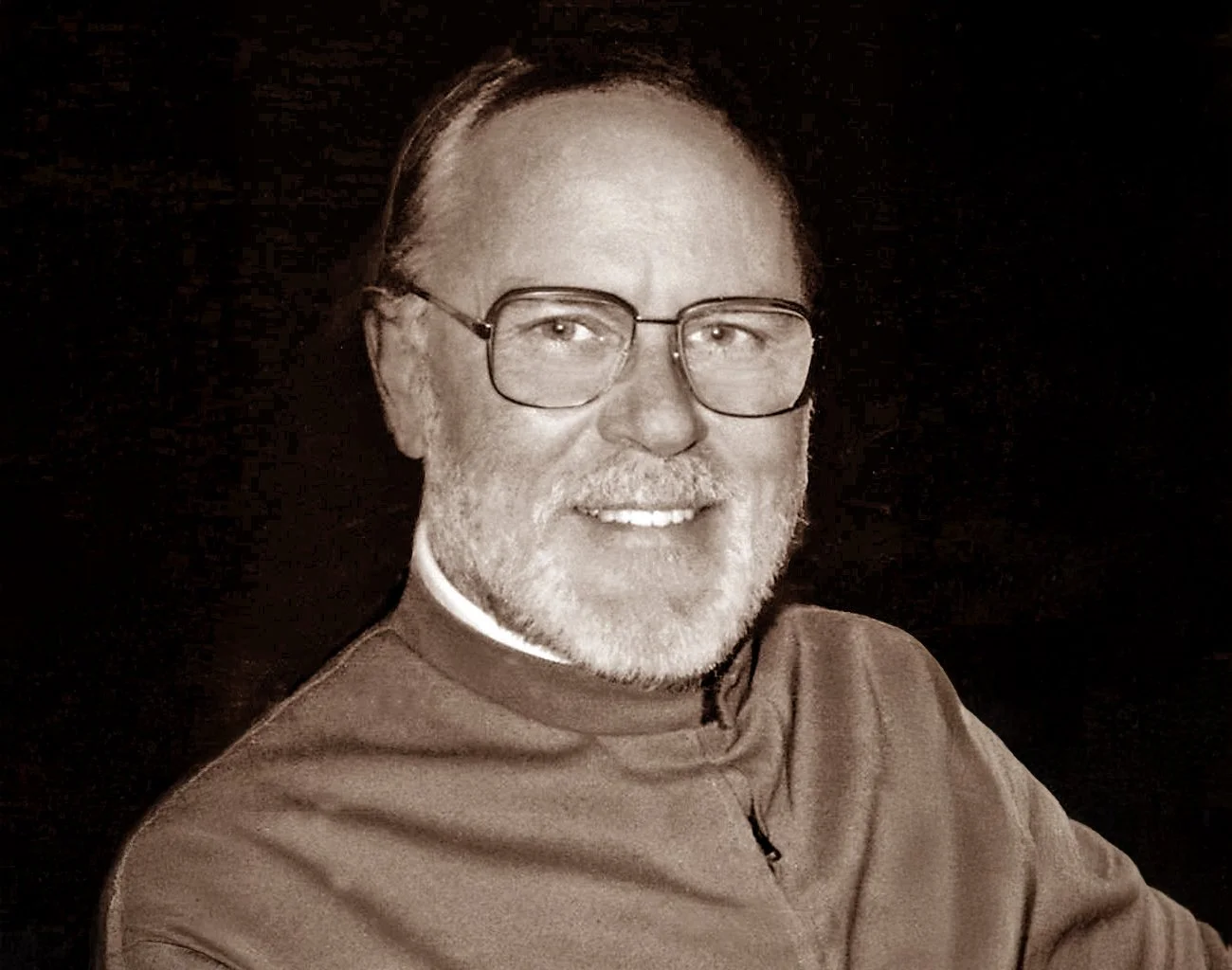
Meditation teacher Fr John Main.
Benedictine monk John Main, whose centenary occurred this year, was a remarkable teacher of meditation. Author and theologian Dr Sarah Bachelard* reflects on how he shaped and inspired her own faith journey and meditation practice, and how his simple teaching, which led to the creation of the World Community for Christian Meditation, can open our hearts and minds to Jesus as a living presence, and receive his love as pure gift.
John Main’s teaching on Christian meditation has been integral to my life journey, but my relationship with his teaching has changed significantly over time. To begin with, I found John Main way too ‘Christian’ for comfort. Now, it’s his vision of Christ at the heart of things that speaks to me deeply. I realise then there’s a sense in which I can map or trace changes in my own prayer and faith with reference to changes in my response to John Main. I’d like to share something of this journey with you here.
This year, he would have turned 100. He was born on January 21, 1926 in London, to Irish parents. The fourth of six children, he was called Douglas Victor Main but took John as his religious name when he entered the Benedictines in 1959. His journey with meditation had begun several years prior to this, while he was serving in the British diplomatic service in what was then called Malaya. The introduction came about when, as part of his diplomatic duties, Main was sent to deliver a goodwill message to Swami Satyananda. The Swami was a Hindu monk who’d been educated as a child in a Catholic mission school and gone on to found an orphanage school and ashram in Kuala Lumpur.
On his visit, John Main asked the Swami to speak of the spiritual base of the good works carried out at the orphanage and school. The Swami replied that it was the daily practice of meditation. John Main later wrote: ‘I was deeply impressed by his peacefulness and calm wisdom. For the Swami, the aim of meditation was the coming to awareness of the spirit who (in the words of the Upanishads) dwells in our hearts, who enfolds the whole universe, and in silence is loving to all’.[1] According to his biographer, ‘John Main was so moved by this passage … and the Swami’s spiritual intensity that he asked to be taught to meditate’. The Swami agreed, but insisted that his young Christian visitor meditate with his Christian faith and gave him a Christian mantra. And so began John Main’s own deeper journey in prayer whose fruits issued ultimately in the formation of the World Community for Christian Meditation.
Well, despite growing up in the church and having a degree in theology, I had never heard of John Main until I stumbled across the existence of the World Community in 2001. At that time, I’d been meditating intermittently using a breath practice I’d learned from reading Buddhist teachers, Thich Nhat Hanh and Pema Chodron. I’d been outside the church for about 10 years, but this practice of meditation and the wisdom of these Buddhist teachers had begun to awaken in me some renewed sense of the depth dimension of my own tradition. I was starting to attend church again, but silent meditation was still the only way I could imagine praying. Seeking to make some theological sense of it all, I was delighted to discover, through the WCCM, the possibility of connecting a practice of meditation with my own tradition.
What made WCCM so appealing to me at that time was that it didn’t smack of the Christian complacency or triumphalism that had so turned me off the church in the past. John Main had learned to meditate with a Hindu teacher, and a commitment to interfaith friendship and dialogue continued to permeate his community. There was no sense of being over against other traditions, and this meant that my own tentative reconnection with my Christian roots did not have to imply rejection of the wisdom I’d found in other paths. In fact, at this point, when I did try to read some of John Main, I found it rather off-putting. He was so deeply Christian; he framed the teaching of meditation in language to which I still had a kind of allergic reaction. So I felt a little ambivalent about John Main himself. Yet the meditation felt true and at some point (after initial reluctance) I changed from a breath practice to a mantra-based practice, using John Main’s prayer word – Maranatha.
In 2003, I moved house, sharing a rental place with a friend. It was basically unfurnished, but the owners had left a few books on a shelf. Bizarrely – providentially perhaps – these included two books by John Main. I can’t now remember which ones – maybe Word Made Flesh and Moment of Christ – I took these books into my bedroom, and I used to read a chapter before I went to sleep each night. By this stage, I was less allergic to his language, and though I still didn’t understand much of what he said, his words had an effect. It was as if they took me into a deeper, more spacious place … as if I were taking something in by osmosis. Towards the end of that rather turbulent year, I committed to the twice daily practice of meditation. Within about 6 months, I’d let myself hear a call to ordination.
So what’s been so significant for me in John Main’s teaching on prayer? What do I find life-giving in it? I am going to touch on three aspects in particular.
First, I love the rigour of the practice he teaches. John Main’s instruction on how to meditate is simple: Sit still with your back straight. Close your eyes lightly. Then interiorly, silently, begin to recite a single word – a prayer word or mantra. John Main insisted on the necessity (which he learned from his own teacher) of saying the mantra continuously, from the beginning to the end of the meditation period; and he insisted on giving up any seeking for ‘experiences’ in prayer, any special effects or feelings. We are to meditate without constantly checking our spiritual and emotional pulse, without becoming preoccupied with what we’re ‘getting out of it’. We are to meditate ‘for nothing’, simply because God is God.
Some react to the austerity of this. I’ve heard people complain, for example, that John Main’s teaching about the mantra is rigid or that he doesn’t give enough guidance about different stages of meditation and our changing relationship with the mantra. Some react to the idea that our ‘experiences’ in prayer should be effectively ignored or discounted – surely if we feel an inrush of peace, for example, or have a profound insight or vision, God would like us to turn our attention from the repetition of the mantra to enjoy the gift?
Well, in fact, John Main did say that if we find ourselves caught up in contemplation beyond self-consciousness, where the mantra simply falls silent of its own accord, then that is indeed the gift of God. But the minute we begin ‘consciously’ to possess or enjoy the state we’re in, to reflect on the experience we’re having, then we are no longer in a state of contemplation – and we must return gently and faithfully to the mantra. The reason?
John Main is profoundly alert to what Iris Murdoch called ‘the fat, relentless ego’, the acquisitive, self-aggrandising habits of heart and mind that keep us obsessed with ourselves, our achievements, our security, our image. He’s deeply aware of the dangers of what he called ‘spiritual materialism’, that seeking after (and sometimes manufacturing or persuading ourselves of) experiences that make us feel special, or holy, or favoured above others. It’s so easy for our spiritual seeking to be corrupted by the religious ego, and for our interest in subtle refinements of practice to reflect a self-conscious preoccupation with technique – as if it’s our mastery of a ‘technique’ that determines our spiritual progress or asserts some claim on God’s attention.
I think much of my early spiritual seeking was misdirected in this kind of way. I wanted to have an ‘experience’ of God or the Spirit, I wanted to possess something for myself. When I didn’t have such ‘experiences’ I felt inadequate, disappointed, rejected; if I did have something approximating an ‘experience’, I wanted to hang on to it, recreate it. Part of what I found so liberating about John Main’s refusal of the seeking after ‘experience’ was that it cut through this futile self-preoccupation, this sticky attachment to my desired outcomes, and left me with the simple discipline of other-directed attention which I was invited to trust. What I felt or didn’t feel wasn’t the issue. The only point was to be open to what was really there.
And yet, though I found this teaching bracingly uncompromising and unsentimental, it was also gentle – and this too was a sign, to me, of its authenticity. John Main knew that most of us do begin as spiritual materialists, chronically seeking to be reassured about our acceptability, our belonging, our progress. So he says all there is to do, when we realise we’ve been caught up again in our fantasies, when we can’t seem to disentangle ourselves from our spiritual ambitions and projections, is to recognise that’s happened. There’s no need to beat yourself up. Be humble, be gentle, return to the mantra and the commitment to letting yourself go. Do your best, try again. It’s a profoundly humane, profoundly Benedictine, spirit.
Because – and this is my second point – John Main insists, in accord with all true teachers of Christian prayer, that ultimately our prayer isn’t ours. In meditation, we’re not achieving some feat of transformed consciousness but simply disposing ourselves as humbly and generously as we can to receive what can only be given. Rowan Williams has said that ‘in a nutshell’, Christian prayer is ‘letting Jesus pray in you’. It’s not badgering God with our agenda, but learning to align our hearts with the heart of God, as Jesus did, becoming those through whom the eternal love of God can pour.[2] John Main put it this way: ‘It is our conviction that the central message of the New Testament is that there is really only one prayer and that this prayer is the prayer of Christ … I can describe it only as the stream of love that flows constantly between Jesus and the Father. This stream of love is the Holy Spirit’. The most important task for any fully human life, he went on, is ‘to allow this prayer to become our prayer’.[3]
In this, according to John Main, Jesus himself is our guide. He wrote: as our distractions lessen and our meditation deepens, ‘as we approach the centre of our being, as we enter our heart, we find that we are greeted by our guide, greeted by the one who has led us’ and that ‘our guide is Jesus … the man wholly open to God’.[4] When I first read this, I didn’t know what it meant. I had no felt sense of being caught up in a prayer that was deeper than my own efforts. I had no sense of encountering Jesus in my heart. In fact, I had all kinds of questions. Who says it’s Jesus? If meditation is a universal practice which connects us (as John Main also says) to the energy at the heart of creation, why do we even need Jesus? Can’t we just meditate, get past our divided consciousness and find ourselves in union with all?
Well, to explore this theologically would take much more space than I have here. But in some mysterious way, it’s as if John Main’s teaching here has come true for me. It’s not that I’ve ever had a vision of Jesus meeting me in the silence, nor heard his voice speaking to me. It is simply that I am more and more aware of a presence I can only name in that way. Laurence Freeman has said that early in his training with John Main, he gradually ‘came to see how deeply central Jesus was to [him], not just as a religious symbol. I came to see how Jesus lived in John Main’s own person as a living presence, in a personal relationship that was hidden (mysterious) but not secretive’.[5] I did not expect or anticipate that something like this would happen for me, and yet somehow I find myself here.
And this leads me to the third aspect of John Main’s teaching I’d like to highlight. It’s the sense of being led in and through Christ into participating in a larger Life. In meditation, we come home to ourselves, becoming more integrated and at peace. But this is not the end of the journey … and as we continue to turn our attention beyond ourselves in a practice of radical silence, there’s an ever-deepening kenosis or self-emptying. John Main spoke of this in terms of the paschal mystery – we are being led to a kind dying to self; we are being drawn across the threshold of the narrow gate.
‘As we approach that point’, he wrote, ‘it seems that we require great courage. It seems that we require great perseverance’. But, he testified, the courage we need is given us by Jesus who has already accomplished this Passover, and whose love takes us through into ‘the infinite expansion that is God’.[6] ‘We have to remember’, he wrote, ‘that the axis of Christian life is death and resurrection … Jesus tells us that if we are open to him, if we have the courage to listen to him, to hear what he says, then eternal life, infinite life and the infinite expansion of life is ours’.[7] This, as Williams has said, ‘is to be open to all the fullness that the Father wishes to pour into our hearts’. It is to embark ‘in endless growth towards love’, ‘a journey without end to find our way more deeply … into the heart of the Trinitarian life’.[8]
People sometimes ask, ‘what makes Christian meditation Christian?’ After all, it’s not as if there’s something obviously distinctive about the method in itself. John Main always said what makes it Christian is the faith of the person meditating, and that to be a Christian means ‘to live your life out of the resources of your union with Christ’.[9] Does this mean that someone who meditates as a Christian ends up in a different place or differently transformed than, say, a Buddhist meditator? Or does it just mean they name or interpret their experience in different terms? Well, I’m not sure. I suspect only someone deeply formed in both traditions would really be in a position to engage such questions seriously.
For me, though, John Main is the teacher who has taught not only the practice of meditation, but an interpretation of that practice, which seems to verify ‘the truths of my faith in my own experience’. By means of this practice, I am beginning to realise a living connection with the Trinitarian love at the heart of creation, and by which I know myself being slowly transformed. And I am thankful.
*Dr Sarah Bachelard is the spiritual director of Benedictus Contemplative Church in Canberra, Australia. Sarah is a theologian, retreat leader and a teacher in the World Community for Christian Meditation. She is the author of Pools of Grace: The Gift and Call of Contemplative Worship; Experiencing God in a Time of Crisis; Resurrection and Moral Imagination; A Contemplative Christianity for Our Time; and Poetica Divina: Poems to Redeem a Prose World.
This article is a slightly edited version of an online talk Dr Bachelard gave at The Well, in which the speakers are invited to reflect on how a mystic or poet has been a source of Living Water in their lives. See the recording here (Passcode: u@bt!45%): (https://us02web.zoom.us/rec/share/ySRS6YLoEXattOxt5O75ydeiqcPtPljnwnUG_wqDia_Z97eTtmtqXfmcHSQsWyWU.fa7vI3E7jDMXAPWo
At the next meeting of The Well, on Sunday 2 August at 7.30pm (AEST), scholar, translator and poet Dr Mark S. Burrows will reflect on how 14th century mystic Meister Eckhart has nourished his faith. Click here for more information and the zoom link: https://www.thelivingwater.com.au/events
References:
[1] Paul T. Harris (ed), John Main: A Biography, first published 2001 (Singapore: Medio Media, 2010), pp.21-22.
[2] Rowan Williams, Being Christian (London: SPCK, 2014), p.63.
[3] John Main, Moment of Christ: Prayer as the way to God’s fullness (Norwich: Canterbury Press, 2010), p.x.
[4] Main, Moment of Christ, p.11.
[5] Laurence Freeman, Jesus the Teacher Within (New York and London: Continuum, 2003), p.17.
[6] Main, Moment of Christ, p.15.
[7] Main, Moment of Christ, p.15.
[8] Rowan Williams, The Archbishop of Canterbury’s Address to the Thirteenth Ordinary General Assembly of the Synod of Bishops on the New Evangelization for the Transmission of the Christian Faith, 10 October 2012, para.6.
[9] Main, Moment of Christ, p.20.